Confessions of an Ugly Stepsister, by Gregory Maguire
Frankly, much of contemporary adult fiction tastes stale when you're used to the intense flavors of YA. I read this as research for my own story set in 17th-century Holland, but I had to make myself stick with it.
Along for the Ride, by Sarah Dessen
I actually liked this. I'm not a chick-lit fan, but Along for the Ride worked.
Don't Judge a Girl by Her Cover, by Ally Carter
Lite spy-lit, the third in a series. Good story, but the way Carter raises more questions than she answers about our heroine, almost feels like a filler episode in some ways.
Eyes Like Stars, by Lisa Manchev
Come back next week for a review with the Kidz Book Buzz blog tour.
George Müller, by Janet & Geoff Benge
Interest-keeping bio.
The Forest of Hands and Teeth, by Carrie Ryan
Totally unexpected thumbs down. Bloggers can't stop raving, and yes, the writing kept me up all night, but the worldview was bleak!! And the heroine never grows out of her selfishness! Problematic.
The Amaranth Enchantment, by Julie Berry
Light and frothy, a fun middle grade fairy tale.
The Evolution of Calpurnia Tate, by Jacqueline Kelly
Darkwood, by M.E. Breen
Strawberry Hill, by Mary Ann Hoberman
The Reluctant Heiress, by Eva Ibbotson
Proverbs, I Corinthians, II Corinthians, Galatians, KJ Version

Carnegie Medal
On my nightstand for July
Two lovely ARCs, courtesy of Egmont USA:
Candor, by Pam Bachorz
Leaving the Bellweathers, by Kristin Clark Venuti
And an assortment of other titles:
Cry, The Beloved Country, by Alan Paton
The Locked Garden, by Gloria Whelan
The Mind of the Maker, by Dorothy Sayers
Seven Reasons Why You Can Trust the Bible, by Erwin Lutzer
The Greatest Among You, by Randy Sims
When You Reach Me, by Rebecca Stead
Still plugging away at Les Miserables. Perhaps July will be The Month!
How about your nightstand?
EDITED to remove Along for the Ride, by Sarah Dessen and replace it with The Mind of the Maker, by Dorothy Sayers. Because, um, I sat down and read Along for the Ride tonight.
Candor, by Pam Bachorz
Leaving the Bellweathers, by Kristin Clark Venuti
And an assortment of other titles:
Cry, The Beloved Country, by Alan Paton
The Locked Garden, by Gloria Whelan
The Mind of the Maker, by Dorothy Sayers
Seven Reasons Why You Can Trust the Bible, by Erwin Lutzer
The Greatest Among You, by Randy Sims
When You Reach Me, by Rebecca Stead
Still plugging away at Les Miserables. Perhaps July will be The Month!
How about your nightstand?
EDITED to remove Along for the Ride, by Sarah Dessen and replace it with The Mind of the Maker, by Dorothy Sayers. Because, um, I sat down and read Along for the Ride tonight.
Kidz Book Buzz Blog Tour: Darkwood (Pass the Laptop)
 My brother Robbie (16) and I are sitting side by side, but we’re pretending to be oceans apart, chatting about M.E. Breen’s Darkwood. I’ll be in England.
Robbie: I’ll be somewhere in the Artic Circle. With my pet polar bear and black wolves.
Noel: Alright then. Darkwood. Where would you like to start?
Robbie: Kinderstalk.
Noel: Okay. What about them?
Robbie: They’re slightly freaky. No, don’t write that. (The polar bear is transcribing now. a.k.a. Robbie got tired of passing the laptop.) Kinderstalk are mysterious creatures that prowl the dark forest.
Noel: Um, that’s from the product description, isn’t it?
Robbie: I left out “Howland’s” dark forest. They seem very fairy-tale-ish, if that’s a word. And the fact that they—
Noel: Spoilers!
Robbie: Oh, sorry. You write some stuff now. (Note to polar bear: you don’t have to take down everything I say.)
Noel: Well, I felt like Darkwood was a very plot-driven story. Our heroine, Annie, is moved from place to place, event to event, and there aren’t many monotonous passages. Do you agree?
Robbie: Yeah, I definitely think it was a fast read, and it kept your attention. You wanted to read more.
Noel: Was there ever a point that you were confused, didn’t understand what was going on?
Robbie: I think that there were a few parts I couldn’t grasp, but if I went back and read it again, I could figure it out. The author had you figure some things out on your own, instead of spelling everything out. Makes the reader feel smart, I think, when they can figure something out. And the typeset is really cool, too.
Noel: What did you think of Annie’s cats?
Robbie: I thought it was kind of weird that they knew everything she needed. But at the end it came together—they had been sent as protectors. I’d never really thought of cats as that intelligent.
Noel: Yeah, well, Rillian [our current puss] mainly sits on the boat cover. So I can see how that would throw you off. What was your favorite thing about Darkwood?
Robbie: I liked how the events of the story were woven into the characters’ past and future. Everything fell into place nicely. Do think it was a little unrealistic how the humans could communicate with the Kinderstalk in wolf-language?
Noel: I don’t know. I guess it would look/sound funny if you saw a human snarling and grunting to an animal, but in the context of the story… well, they needed communication. And if Doctor Doolittle could do it… (I refer solely to the literary Doctor. Banish images of Eddie Murphy from your mind.)
Robbie: Well, I have to go fish some people out of the frigid waves.
Noel: (Actually, our Dad needed his help.) I guess that’s it, then. Goodnight, Chicago!
Kidz Book Buzz Blog Tour: Darkwood (A Look at the Writing)
 What makes a character enjoyable to me?
I like someone who breathes:
Dazed, Annie followed the enormous woman through a tiny gate into a tiny yard bordering a tiny cottage. Serena bent over almost double to fit through the door. Inside, the ginger colored bun on the top of her head was flattened against the ceiling....
A woman appeared in the kitchen doorway, holding out her arms and smiling. “Serena, back at last.”
Beatrice was a perfect replica of her sister: only where Serena was very large, Beatrice was exceptionally small, down to the tiny ginger bun perched on top of her head. Serena stepped forward to embrace her sister and for a moment Annie thought she would take the roof of the cottage with her.
....
“Now what would you like for dinner? We’ve got eggs and cheese and some decent bread—a bit hard, but only at the heel, and that’s all right if you want to make frogs-in-a-hole...”
....
She did not know what to say. She held Bea’s hand. Bea’s palm was soft but each of her fingers had a callus at the tip from working the loom.
I like someone who sparkles:
“Yes, you two—get going. There are extra blankets in the back, and a canvas if it gets really wet. And mother’s pistol.”
....
When neither Page nor Annie moved, she sighed, hands on hips. “Listen, you two sprouts. I’ve seen more strange things in my life than you can imagine. This ranks among them, but it hasn’t curled my hair yet.”
I like a character whose absence would dullify the book—but on the flip side, if the entire cast were these special treats, the story would border on ridiculous.
Kind of like real life, isn’t it? You know nice people, and then you know people that breathe and sparkle. Life wouldn’t be the same without them, but life wouldn’t be the same with too many of them. (The image in my head is Monty Python’s Bicycle Repairman sketch, with all those Supermen sitting at the barber’s, taking the bus ... creepy.)
Breen’s Serena and Beatrice add just the right touch to Darkwood’s cast of characters.
Kidz Book Buzz Blog Tour: Darkwood (Review)
 Often, I’m informed that a book is amazing, stupendous, read-it-you’ll-love-it—but when I actually do read it, I blink a few times and wonder where they were wandering.
With Darkwood, it was the other way around. Everywhere I looked, people were saying ... eh. But when I actually read the book, I kept turning pages, wondering when the boredom would hit.
It never hit.
Darkness falls so quickly in Howland that the people there have no word for evening. One minute the sky is light, the next minute it is black. But darkness comes in other forms, too, and for thirteen-year-old Annie, the misery she endures in her Uncle’s household makes the black of night seem almost soothing. When Annie escapes, her route takes her first to a dangerous mine where a precious stone is being stolen by an enemy of the king, and later to the king’s own halls, where a figure from Annie’s past makes a startling appearance. All the while, reported sightings of kinderstalk— mysterious, wolf-like creatures that prowl Howland’s dark forests—grow more frequent. Eloquent, suspenseful, and imbued with fairy-tale motifs found in The Brothers Grimm, this is a riveting coming-of-age story of a girl who must learn to trust her instincts if she’s to lead the people she is destined to rule.
So what’s earning Darkwood these one thumb downs? Perhaps the plot-driven factor. While there are several engaging characters, people don’t really propel the story. As a lover of character-driven novels myself, I did recognize a point when my interest really pricked: our heroine crossed paths with a pair of enjoyable sisters. I’ll wager some of the other tour participants warmed up to Darkwood about that time.
Another criticism I read was choppy flow. Breen’s block style does feel awkward at first—each chapter is divided into an average of six portions. But once you get used to the cradle-rocking, this format reads well: like hopping from lily pad to lily pad in pursuit of a big fat fly. Crouching and landing fade to the back of your mind as you focus on the chase.
I’m not saying the book never stumbled. There was a time or two that I mentally clucked, when a direction-changing speech felt shaky, or a sequence moved too fast. But all things considered, (“all things” meaning my hawk eyes, thanks to negative reviews), Breen escaped quite well. :)
I’ve said before that I’m not a huge fan of far-world fantasies. Sometimes an author’s world-building is wearisome beyond belief. But Breen slips in a brick here and a bit of mortar there, without burdening the reader. For example: “Go get the almanac. I saw it in the kitchen...” Like most people, Beatrice and Serena kept maps at the back of their almanac. Page opened the map of Howland and laid it next to the old map.” Or, “Bea had baked a dozen dandelion muffins.” Simple, yet full of flavor.
Tomorrow, I’ll post some favorite excerpts and talk about what made certain characters pop, but in the meantime, snitch a bite of the writing and judge for yourself:
“Then, as they crested a hill the great city itself appeared, a simmering white mass, with the palace perched above it like the top layer of a wedding cake.”
“The bindweed groaned as it loosed itself from the stone, one fingerlike branch after another snapping free. The top of the vine, already loose, had curved over itself like a question mark, its leaves hissing and whispering as they fell.”
.
Note: You know what Darkwood’s aftertaste reminded me of?
Just how much of a final verdict is determined by expectations, do you think?
Kidz Book Buzz Blog Tour: Darkwood
 Darkwood
by M.E. Breen
Bloomsbury
Ages 10 – 14
288 pages
Check out other participating bloggers:
A Patchwork of Books
Abby the Librarian
All About Children’s Books
Becky’s Book Reviews
Cafe of Dreams
Dolce Bellezza
Hyperbole
KidzBookBuzz.com
My Utopia
Through a Child’s Eyes
Through the Looking Glass Reviews
But if you’ll please leave your name, number, and a brief message...
I’ll be out of town this coming week, in a land with no internet! ... no ipods!! ... no cell phones!!! ... oh wait. I don’t have a cell phone.
It’s not fat camp, despite the torturous description.
But come back tomorrow (and Tuesday, and Wednesday) for scheduled posts: a blog tour of M.E. Breen’s debut novel, Darkwood.
It’s not fat camp, despite the torturous description.
But come back tomorrow (and Tuesday, and Wednesday) for scheduled posts: a blog tour of M.E. Breen’s debut novel, Darkwood.
Concept Art
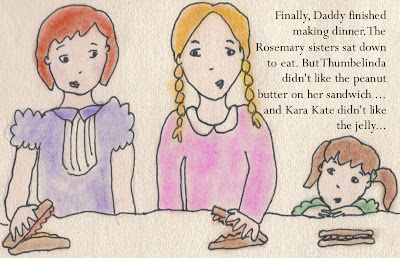
Sketches of the aforementioned Rosemary Sisters. I love ink and pastels. I posses just enough talent for fun and frustration.
.



All in a day's work
In our library, the youth department is on the basement floor. So when patrons walk in, you can hear (adults) go up and (children) come down.
The front door opened, and a small voice echoed down the stairs.
"Dad, can we go down and look at the good books?"
The front door opened, and a small voice echoed down the stairs.
"Dad, can we go down and look at the good books?"
I'm up at Novel Journey today...
...interviewing Ingrid Law, of Savvy fame. It's a repeat interview of one I posted here a month or two ago, but there are a couple of bonus Q&As.
Scoop of the e-e-evening: The Evolution of Calpurnia Tate

Evolution.
.
Such a small word for such a tall order—“the gradual development of something into a more complex or better form.” How much of a person’s evolution is concentrated between the years of ten and twenty? How does that new complexity influence the rest of our lives?
.
Evolution.
.
Such a small word for such a pervasive hypothesis— “the theoretical process by which all species develop from earlier forms of life.”
.
Jacqueline Kelly has woven both aspects into her debut novel, The Evolution of Calpurnia Tate. It’s a growing year for our twelve-year-old heroine, a year in which she wakes to the world of The Great Man himself: Charles Darwin.
.
I liked this book too much to go off on an enormous tangent, but I also respect young readers too much to forgo mentioning the novel’s problems. The problems are not really Miss Kelly’s fault. She’s just another student of the widespread belief that Darwinian Evolution has been proven beyond doubt.
.
But the last time I checked, it was still the "theory of evolution."
.
Each chapter opens with a fitting quote from Darwin’s Origin of the Species, fairly chewy paragraphs for middle-grade readers. I’m not opposed to children reading The Origin of the Species—science is investigation. Origin should be read. However, I think that by quoting bits and pieces, and referring to Darwin as The Great Man, Kelly only reinforces what kids hear in school every day: out of the mouth of Darwin = wisdom.
.
Here are questions for a truly open mind: what about the gap between nothing and matter? What about the gap between matter and life? What about the gap between man and lower creation? As Calpurnia learns, science means "making your Hypothesis and devising your Experiment, and testing by Observation, and coming to a Conclusion. And then testing the strength of your Conclusion, over and over."
.
Now, reading is like life: you can’t pick out the pieces you like and leave the rest. There are flies in The Evolution of Calpurnia Tate, and I can’t ignore them. But there is also delight in this story, and I can’t ignore it, either. Prepare yourself. (Skip down to the bottom for final thoughts, if you're despicable enough to tire of the quotes.)
.
“…the next time there’s a funeral in town, will you take me?” “Callie Vee.” “There’s nothing creepy about it. It’s scientific interest. Backy Medlin looks kind of decrepit to me. How old is he, do you reckon?” “Why don’t you go down the street and inspect his teeth?” “That’s a good one, Harry, but I doubt he has any left. He’ll go soon, don’t you think?”
.
On the long drive back to Fentress, my grandfather and I had energy to spare. We burned up some of it singing sea chanteys and pirate songs with naughty words, being careful to switch to hymns when other riders came into view.
.
… the long scarf I was knitting bulged in the middle like a python after dining on a rabbit.
.
And if I had a budgie, would I be allowed to let it fly loose in the house? Probably not. It would drop white dollops like antimacassars on the good furniture, and that would be the end of that. And you couldn’t forget Idabelle the Inside Cat in her basket by the stove. Maybe I could let it fly in my bedroom. It could perch on my headboard and chirrup in my ear, a pleasant sound—“Calpurnia!” I jumped. “Yes mother?” “You’re not listening to me!” I stared at her. How could she tell?
.
Doomed to the distaff life
.
“I know you’re up there,” said Mother, “and I know you can hear me. Come down here.” I sighed, slipped an old hair ribbon into [A Tale of Two Cities] to mark my place, and trudged downstairs. I was the condemned young aristocrat holding my head high in the tumbrel. It was a far, far better thing—“There’s no need to look like that,” said Mother as I walked into the kitchen….
.
“Boys, I have an announcement to make. You sister made the apple pies tonight. I’m sure we will all enjoy them very much. “Can I learn how, ma-am?” said Jim Bowie. “No, J.B. Boys don’t bake pies,” Mother said. “Why not?” he said. “They have wives who make pies for them.” “But I don’t have a wife.” “Darling, I’m sure will have a very one someday when you’re older, and she’ll make you many pies….” Was there any way I could have a wife, too?
.
Helen Keller could have seen what was coming, so why couldn't my parents?
.
The [smashed] mosquito was a clear success in terms of getting plenty of food, but a failure in terms of living to a good old age and expiring peacefully in her sleep, surrounded by her many keening grandchildren. So was she fit or unfit?
.
I loved the Tate family. I loved watching the interplay between seven siblings--you don't get that very often. I loved the generation-spanning relationship between Callie and her grandfather. These things breathed.
.
Though the chapters are slightly episodic, Kelly always brought a thread of the previous episode into the following chapter, just enough to affirm and tie things together, keeping a golden stitch running continuously through the book.
.
Final verdict? The Evolution of Calpurnia Tate made my Favorite Books of 2009 (so far) list, despite my reservations regarding The Great Man. The writing is just that good. Read it for yourself--but remember, as you keep your mind wide open, don't let your brains fly out.
Comes and Goes Like Fitz and Dizzyspells
Saturday was
a good day.
Babysitting three of my cousins inspired the text for a 450-word picture book about three little girls, the Rosemary sisters: Thumbelinda, Kara Kate, and Pinky (my cousins helped with the names). The oldest Rosemary sisters, Thumbelinda (of the blonde hair) and Kara Kate (of the red) are two peas in a pod. Their younger sister Pinky watches them. It’s fun. I’ll be working on illustrations now.
Then, thanks to Mike Duran, I blew a chunk of money on Andrew Bird* and The Decemberists. Check out, if you don’t already like them.
Finally, in a grand golden fit of inspiration, I blocked a sizable portion of my new novel, and came up with a title I really like:
Goodly Wings.
Sufficiently fairytale-ish for a Beauty-meets-Jane-Eyre märchen rooted in Grimms’ Six Swans, with “goodly” providing a splash of the 17th-century setting I want. (The phrase is found in Job, fyi.)
I suppose if clever days came every day, we wouldn’t appreciate them. But I wouldn’t mind a few more frequent fitz.
*to whom I owe this post’s title
a good day.
Babysitting three of my cousins inspired the text for a 450-word picture book about three little girls, the Rosemary sisters: Thumbelinda, Kara Kate, and Pinky (my cousins helped with the names). The oldest Rosemary sisters, Thumbelinda (of the blonde hair) and Kara Kate (of the red) are two peas in a pod. Their younger sister Pinky watches them. It’s fun. I’ll be working on illustrations now.
Then, thanks to Mike Duran, I blew a chunk of money on Andrew Bird* and The Decemberists. Check out, if you don’t already like them.
Finally, in a grand golden fit of inspiration, I blocked a sizable portion of my new novel, and came up with a title I really like:
Goodly Wings.
Sufficiently fairytale-ish for a Beauty-meets-Jane-Eyre märchen rooted in Grimms’ Six Swans, with “goodly” providing a splash of the 17th-century setting I want. (The phrase is found in Job, fyi.)
I suppose if clever days came every day, we wouldn’t appreciate them. But I wouldn’t mind a few more frequent fitz.
*to whom I owe this post’s title
All in a day’s work
Or, Help! There’s a short in my savvy!
Used to be, in the golden days long past, you could count on a few things from a guy in a library. For one, he could usually read, and quite often, he checked out a book. Heck, you might even exchange a few intelligent sentences. He possessed Potential.
But with the advent of patron computers, everything changed. Now, a male entering the library carries no guarantees.
Exhibit A: A guy, around seventeen, at the computer bay across from my desk. A regular Runescaper—you know the type. At closing time, I leave the room to lock up, and when I come back, there's a paper on my desk.
Call me.
With his name and number.
…
I take comfort in Anne and Emily. Remember this one?
“Billy wants to marry you,” said Jane. “He’s always been crazy about you—and now father has given him the upper farm in his own name and there’s nothing to prevent him from getting married. But he’s so shy he couldn’t ask you himself if you’d have him, so he got me to do it. I’d rather not have, but he gave me no peace till I said I would, if I got a good chance. What do you think about it, Anne?”
As Montgomery says a page later, There was romance for you, with a vengeance!*
Or how about the drive-by passion in Emily’s Quest?
I was going to pick one paragraph for you, but croopus, I’m on the floor here, dying with laughter. You must read the whole thing (scroll to Part II). Ah, Montgomery.
*Okay, obviously this kid wasn’t proposing, but I have to include this, because there is a strain of my feelings in it: “It’s awfully funny—and yet there’s a sting in it, too, somehow.” Anne knew quite well wherein the sting consisted, though she did not put it into words. She had had her secret dreams of the first time some one should ask her the great question. And it had, in those dreams, always been very romantic and beautiful: and the “some one” was to be very handsome and dark-eyed and distinguished-looking and eloquent, whether he were Prince Charming to be enraptured with “yes” or one to whom a regretful, beautifully worded, but hopeful refusal must be given. If the latter, the refusal was to be expressed so delicately that it would be next best thing to acceptance, and he would go away, after kissing her hand, assuring her of his unalterable, life-long devotion. And it would always be a beautiful memory, to be proud of and a little sad about, also.
Used to be, in the golden days long past, you could count on a few things from a guy in a library. For one, he could usually read, and quite often, he checked out a book. Heck, you might even exchange a few intelligent sentences. He possessed Potential.
But with the advent of patron computers, everything changed. Now, a male entering the library carries no guarantees.
Exhibit A: A guy, around seventeen, at the computer bay across from my desk. A regular Runescaper—you know the type. At closing time, I leave the room to lock up, and when I come back, there's a paper on my desk.
Call me.
With his name and number.
…
I take comfort in Anne and Emily. Remember this one?
“Billy wants to marry you,” said Jane. “He’s always been crazy about you—and now father has given him the upper farm in his own name and there’s nothing to prevent him from getting married. But he’s so shy he couldn’t ask you himself if you’d have him, so he got me to do it. I’d rather not have, but he gave me no peace till I said I would, if I got a good chance. What do you think about it, Anne?”
As Montgomery says a page later, There was romance for you, with a vengeance!*
Or how about the drive-by passion in Emily’s Quest?
I was going to pick one paragraph for you, but croopus, I’m on the floor here, dying with laughter. You must read the whole thing (scroll to Part II). Ah, Montgomery.
*Okay, obviously this kid wasn’t proposing, but I have to include this, because there is a strain of my feelings in it: “It’s awfully funny—and yet there’s a sting in it, too, somehow.” Anne knew quite well wherein the sting consisted, though she did not put it into words. She had had her secret dreams of the first time some one should ask her the great question. And it had, in those dreams, always been very romantic and beautiful: and the “some one” was to be very handsome and dark-eyed and distinguished-looking and eloquent, whether he were Prince Charming to be enraptured with “yes” or one to whom a regretful, beautifully worded, but hopeful refusal must be given. If the latter, the refusal was to be expressed so delicately that it would be next best thing to acceptance, and he would go away, after kissing her hand, assuring her of his unalterable, life-long devotion. And it would always be a beautiful memory, to be proud of and a little sad about, also.
Scoop of the e-e-evening: Strawberry Hill
 I’ve been looking forward to Strawberry Hill. We love Ms. Hoberman’s picture book, The Seven Silly Eaters, especially since there are seven siblings in the story, and seven siblings in our home. From what I’d heard, Strawberry Hill was a sweet, simple novel, reminiscent of mid-20th century tales like Betsy-Tacy and All-of-a-Kind-Family. (Not that I’ve read either of those classics, much to my shame.)
When Jeanne Birdsall wrote The Penderwicks, I was exceeding glad to see “unpretentious” making a return, but the book didn’t bowl me over. It’s the same with Strawberry Hill. I’m happy to have an age-appropriate new release to hand to nine-year-old patrons, but the story isn’t going on my Best of 2009 list, as I had hoped it might.
When ten-year-old Allie learns that her family will be moving from a two-family home to their very own house, she’s hesitant until she finds out they will be living on a street with the magical name of Strawberry Hill. That changes everything! But strawberries aren’t the only thing Allie will have to look for in her new neighborhood. From her struggle to find a new best friend to her quest for acceptance at her new school, Allie takes readers on her journey to make Strawberry Hill feel like home.
There were many things to like about Strawberry Hill.
The prose: “I was especially careful with the three teacups my grandmother had brought over with her from Russia long ago. Once there had been twelve of them, my mother told me, but all the others had broken. They were so thin that the light shone through them. And they had borders of tiny pink roses and rims of gold that were almost worn away.”
Small details that paint a vivid picture: “She lives over there.” Martha pointed across the street to a green house with a big front yard. “They hardly ever mow the grass.”
True-to-life characters. Allie is in fourth grade, and she acts like a fourth grader. Hopscotch, paper dolls, chocolate milk and popsicles. The people around her are not without flaws. Her mother worried “about money, about how expensive everything was and how we couldn’t afford to buy things. Sometimes when my father brought back a present for us from Stamford, instead of being happy, she got mad at him.”
Allie reading Mary Poppins aloud over the telephone when her friend has scarlet fever and can’t receive visitors. I liked that a lot.
And there are spots of humor: “Martha said nobody went to heaven except Catholics.... “Don’t listen to all that hogwash,” [my father] said. “Jews go to heaven just like everyone else. We probably even go more because we’re the chosen people. But we don’t brag about it.”
So while I’d hoped Strawberry Hill would be another Penderwicks on Gardam Street—a story I could wave in front of me as I chased down random strangers and begged them to please, please read it!—at least I got another Penderwicks: a breath-of-fresh-air story I can recommend to little girls without a single qualm.
Publication date: July 2009. ARC courtesy of Little, Brown
All in a day's work
 A little girl, fifth grade at the very most, came in, asking if we had an available copy of Twilight.
I shook my head.
She scrunched her mouth, thought a minute, and then asked, "Okay, well, do you have Clementine?"
Such things should not be.
Scoop of the e-e-evening: The Reluctant Heiress
 After a month without fiction, it was delicious to burrow down with The Reluctant Heiress. Once again, Ibbotson’s prose imparted the oil of gladness, and the small world that was 1920’s
 One thing I love about Ibbotson’s characters is the time and space she devotes to her male leads. No Elizabeth Bennett + Ken here. Why, the first 40 pages of The Reluctant Heiress are devoted to Guy Farne, and Guy Farne alone. For Ibbotson, and for the real world, romance means two complete persons. A timely lesson, as I percolate the star-crossed lovers of my own novel.
The Reluctant Heiress may not toe Ibbotson’s high water mark, but when I count the ways I love her, the quotes are endless:
On a skull found by our heroine as an adventurous child, on the south face of their castle’s crag: “She believes it’s a Turk and we never had the heart to contradict her, though it is most unlikely. The Turks were all impaled on the eastern wall.” “We think it was probably a commercial traveler who came to see her great-grandfather.” “About saddle soap,” put in the Margravine. “He came by the front entrance, you see. And poor Rudi was always so impulsive.”
On our heroine’s duties as an under-wardrobes mistress: “Quickly she sorted the mail into the appropriate pigeon-holes, took the director’s letters upstairs to his office, emptied the mousetraps under his desk, riddled and filled the ancient, rusty stove. Then downstairs again to the front of the house to turn on the light, admit the cleaning ladies, and ring the police to inform them that a handbag containing three thousand kroner and a ticket to Karlsbad had been left in row D of the stalls.”
On our villain’s self-sacrifice: “While shopping, she was patient, dedicated, devout. Standing in lace cami-knickers did not chill her, nor did she become overheated when swathed in furs. The distractions that troubled lesser ladies as they stood captive in cubicles—the thought that outside the birds were singing, the glorious summer day passing unseen—never troubled Nerine nor forced her into a hasty choice.”
As the beauty of Mozart washes over an audience: “Darkened by trombones, by muted trumpets and muffled drums, the music spoke now of the poetry of man’s existence, of the necessity of suffering and endurance in the creation of a perfect love. I will be nicer to Mother, thought the Countess Waaltraut, and the acid-penned critic Mendelov, who had come from
On a smultronstalle: “Only it isn’t just literally a wild strawberry place,” Tessa went on. “A smultronstalle is any place that’s absolutely private and special and your own. A place where life is ... an epiphany. Like that very quiet room in the
On life: “When I was little,” she said, “I used to try to stick the leaves back on the trees. I couldn’t bear autumn. I couldn’t bear them to fall.” “And now?” She shrugged. “Look,” she said. “Look what people have to bear.” She led him a little way down a mossy path to a plain green grave with a simple headstone.... Together, they looked at the inscription.
In loving memory of
Bertha Richter, died 1896 aged 75 years
And of her children
Hannah Richter, died 1843 aged 1 year
Graziella Richter, died 1845 aged 6 months
Herrman Richter, died 1846 aged 1 year
Brigitta Richter (Bibi), died 1849 aged 3 months
Klaus Richter, died 1865 aged 24 years
Also of her husband
Johannes Richter, 1st Hungarian Jaeger Regiment, killed in action at Konigsberg, July 1886
.
“When things get bad,” she said, “I think of Frau Richter, who just went on living and living after all those children had died. Look, she lived to be seventy-five! Think of all the Bertha Richters in here ... you can feel their courage, somehow, coming up through the ground.” She turned and led him slowly back to the bench. “These are the people I come for when I’m down, not Beethoven or Schubert. The great people are for the times when it’s good to be alive.”
.
Also, the hero’s secretary is named Thisbe.
Subscribe to:
Posts (Atom)