*denotes a title I resolved to read.
October Reading Log

Hurrah for Karamazov!
I just finished Dostoevsky’s brilliant Brothers Karamazov. Maybe reading it while actually in Russia, having experienced Russia for a few weeks, weighted its influence, but as I listened, again and again I said to myself, I’ll reread this. I’ll read this book over and over, and it will affect me deeper every time.
ReliantK kept running through my head. Their song Forgiven is the perfect playlist for Brothers.
I could quote endlessly: the devil segment! “I did give away an onion.” Ivan’s famous poem. "If I forget thee, Jerusalem..." Lovely, lovely, lovely.
Tolstoy may have woven epic dramas for his characters in War and Peace, but here Dostoyevsky probes the heart.
And if Austen fans think Jane was any sort of pioneer with her fluttery mothers, they’ve never met Madame Hohlakov. That woman!
ReliantK kept running through my head. Their song Forgiven is the perfect playlist for Brothers.
I could quote endlessly: the devil segment! “I did give away an onion.” Ivan’s famous poem. "If I forget thee, Jerusalem..." Lovely, lovely, lovely.
Tolstoy may have woven epic dramas for his characters in War and Peace, but here Dostoyevsky probes the heart.
And if Austen fans think Jane was any sort of pioneer with her fluttery mothers, they’ve never met Madame Hohlakov. That woman!
NaNoWriMo Young Writers Program
 November is National Novel Writing month. While you might be familiar with NaNoWriMo, this would be a great time to direct a few underage creatives to the Young Writers Program's site.
They have all sorts of cool stuff--writing tips, games, work books. Check it out, and encourage the young writers in your life to participate.
I won't be "writing" a novel during November, but the buzz is a good kick in the pants and I've resolved to recommence tweaking The Jonah Bottle. Can't write some things until my reading list is plowed through. But I can tweak.
Crazy-Quilt Reading
 Being a writer sure generates some odd reading lists. My current stack of "research":
 The Curse of Macbeth and Other Theatrical Superstitions: An Investigation, by Richard Huggett
.
Napoleon Bonaparte, by J.M. Thompson
 Seaweed: Nature's Secret to Balancing Your Metabolism, by Valerie Cooksley
I Will be Cleopatra: An Actress's Journey, by Zoe Caldwell
A Treasury of Irish Folklore, by Padraic Colum
Shakespeare Meme
From Becky’s Book Reviews. Feel free to hop on board.
What was your first introduction to William Shakespeare? Was it love or hate?
Dream version: I adored this tiny, blue-cloth, complete set at the public library, and brought home The Tempest at age 14, not understanding much but loving the taste of the words. "This rough magic ..." *sigh*
Reality: (I think.) I imposed Romeo and Juliet on myself as a Freshman, picking it apart with the aid of some old English papers found in a discarded binder.
Trouble is, I can't remember which story actually came first. I like the Tempest version best.
Which Shakespeare plays have you been required to read?
Romeo and Juliet, as noted above, and then … Macbeth, Hamlet (gasp! I never finished Hamlet! I just realized that! I had about ten pages left! But I’ve seen the play.) Julius Caesar, Midsummer Night’s Dream, Henry V and Richard III. Of course, I’ve seen/read a lot more than I’ve studied.
Do you think Shakespeare is important? Do you feel you are a “better” person for having read the bard?
Given. A better person? Morally? Intellectually? No. But I’ve enjoyed life through his plays—reading them, watching them, staging them; their absence would leave a gaping wound, as with any of my favorite stories. Francis Bacon: "Reading maketh a full man..."
Do you have a favorite Shakespeare play?
Three-way tie: Twelfth Night, Macbeth, The Tempest (though I have to admit, of the three, The Tempest is a little lower than the angels).
How do you feel about contemporary takes on Shakespeare? Adaptations of Shakespeare's works with a more modern feel? (For example, the new line of Manga Shakespeare graphic novels, or novels like Something Rotten, Something Wicked, Enter Three Witches, Ophelia, etc.) Do you have a favorite you'd recommend?
I love spins. I love how Shakespeare transcends time and tide.
I very much enjoyed Something Rotten. In fact, I believe every Freshman English teacher should chuck Romeo out the window, hand students a copy of Something Rotten, take them to see Hamlet, and then read and discuss the script.
I also like stories that are centered around the plays, like Ngio Marsh’s Light Thickens, or include performances, like Midsummer Night in D.E. Stevenson’s Celia’s House.
Movies like 10 Things I Hate About You and She’s the Man are fun, too.
What's your favorite movie version of a Shakespeare play?
Oh, without a doubt, the 1996 Twelfth Night with Imogen Stubbs. Quite possibly my favorite film of all time. Please rent it, gentle reader. Please rent it.
What was your first introduction to William Shakespeare? Was it love or hate?
Dream version: I adored this tiny, blue-cloth, complete set at the public library, and brought home The Tempest at age 14, not understanding much but loving the taste of the words. "This rough magic ..." *sigh*
Reality: (I think.) I imposed Romeo and Juliet on myself as a Freshman, picking it apart with the aid of some old English papers found in a discarded binder.
Trouble is, I can't remember which story actually came first. I like the Tempest version best.
Which Shakespeare plays have you been required to read?
Romeo and Juliet, as noted above, and then … Macbeth, Hamlet (gasp! I never finished Hamlet! I just realized that! I had about ten pages left! But I’ve seen the play.) Julius Caesar, Midsummer Night’s Dream, Henry V and Richard III. Of course, I’ve seen/read a lot more than I’ve studied.
Do you think Shakespeare is important? Do you feel you are a “better” person for having read the bard?
Given. A better person? Morally? Intellectually? No. But I’ve enjoyed life through his plays—reading them, watching them, staging them; their absence would leave a gaping wound, as with any of my favorite stories. Francis Bacon: "Reading maketh a full man..."
Do you have a favorite Shakespeare play?
Three-way tie: Twelfth Night, Macbeth, The Tempest (though I have to admit, of the three, The Tempest is a little lower than the angels).
How do you feel about contemporary takes on Shakespeare? Adaptations of Shakespeare's works with a more modern feel? (For example, the new line of Manga Shakespeare graphic novels, or novels like Something Rotten, Something Wicked, Enter Three Witches, Ophelia, etc.) Do you have a favorite you'd recommend?
I love spins. I love how Shakespeare transcends time and tide.
I very much enjoyed Something Rotten. In fact, I believe every Freshman English teacher should chuck Romeo out the window, hand students a copy of Something Rotten, take them to see Hamlet, and then read and discuss the script.
I also like stories that are centered around the plays, like Ngio Marsh’s Light Thickens, or include performances, like Midsummer Night in D.E. Stevenson’s Celia’s House.
Movies like 10 Things I Hate About You and She’s the Man are fun, too.
What's your favorite movie version of a Shakespeare play?
Oh, without a doubt, the 1996 Twelfth Night with Imogen Stubbs. Quite possibly my favorite film of all time. Please rent it, gentle reader. Please rent it.
Kidz Book Buzz Blog Tour: Something Wicked (Giveaway)
 Here's a fun way to enter your name to win an autographed copy of Something Wicked, by Alan Gratz:
Visit this site. Take the quiz to see how well you know Shakespeare's Macbeth.
Come back here and leave your name and score on the comments page. You have until midnight on Halloween.
Then Saturday (Nov. 1), I'll pick a random name from a hat, and we'll have a winner!
*UPDATE* AND THE WINNER IS ... PARADOX!
Kidz Book Buzz Blog Tour: Something Wicked (BONUS POST!)
Seeing as Halloween commences in 48 hours, I thought I'd bring up the little matter of Macbeth being cursed. The play, that is. Though I suppose the man, too.
The curse of Macbeth plays a part in the novel I'm writing, so I dug through my research and now beg to put before you an intriguing piece by Robert Fairies.
The curse of Macbeth plays a part in the novel I'm writing, so I dug through my research and now beg to put before you an intriguing piece by Robert Fairies.
Kidz Book Buzz Blog Tour: Something Wicked (Author Interview--Alan Gratz)
 Tell us about your newest book, Something Wicked.
Something Wicked is Shakespeare's Macbeth recast as a contemporary young adult murder mystery set at a Scottish Highland Festival in East Tennessee. It's the second book in a series of mysteries featuring teenage detective Horatio Wilkes, who is modeled after gumshoes like Raymond Chandler's Philip Marlowe and Rex Stout's Archie Goodwin. In Something Wicked, Horatio has to help his friend Mac, and Mac's girlfriend Beth, out of a little trouble...
I love the Horatio Wilkes series because it opens Shakespeare to a whole new audience: adolescent males. What did you think of Shakespeare as a teenager?
I read Julius Caesar, Romeo and Juliet, and Henry IV for English in high school. I also saw a few plays in production then--A Midsummer Night's Dream, Twelfth Night, The Tempest, Hamlet. So by the time I hit college I had a healthy appreciation for what I had read and seen, which might make me an unusual teen. :-)
I was also interested in playwriting--which I've done as a professional writer--so I had more than a passing interest in Shakespeare even then. I remember too buying for myself one of those terrible leather-bound omnibus editions of Shakespeare's collected works that chain bookstores sell up front in their remainder section. You know, "The Complete Works of William Shakespeare" for $9.95! And of course there's no commentary, no textual footnotes, and all the plays are printed in like six point type. But I bought the thing, and I read it. Not all of it, but I picked out plays that sounded interesting and actually cracked that massive thing open and read it.
Then in college I signed up for two Shakespeare courses, a Tragedies class and a Comedies class--taken in separate semesters, thankfully--and really began to understand the nuances of the plays I had read or seen on my own without annotation. I guess I was becoming a fan, and the college courses sealed it for me.
Why do you write for young people?
Because it's fun! That's really a big part of it. Anything goes now in fiction for kids--particularly in young adult fiction--so everything is fair game. I also like that books for younger readers are plot heavy. Things HAPPEN. There is, of course, always a need for a bit of reflection, but books for young readers aren't full of a lot of philosophizing and poetic musings. Again, there's room for philosophy and poetry, but not at the expense of plot.
When I wrote my first book for young readers, Samurai Shortstop, I made a pledge to myself to make sure something happened in each and every scene to move the story forward. That sounds silly--of course every scene should move the story forward!--but that's not always the case with books for adults.
I often tell people who are aspiring writers for kids that no child ever picked up a book because of the great review it got in The New York Times Review of Books, or ever said, "Well, nothing much has happened in the first 200 pages of this book, but I think I'll give it another hundred pages and see if it picks up." Kids demand stories where the action comes early and often. As a reader, I sympathize, so as a writer I challenge myself to write those kind of books.
What prepared you to write for teenagers?
I've worked as a teacher of both high school and middle school English, and certainly those interactions with teenagers helped. I also remember my middle school and high school days vividly, so it's easy for me to tap into those memories and draw them out on the page.
I also read a lot of young adult and middle grade novels, and those I don't read I at least am aware of to know why they appeal to kids. I was at a writers conference lately where I gave a talk on writing for young readers. As a test, I read aloud a list of books and their authors, and asked my audience to raise their hands if they had even HEARD of the book. I read out six or seven titles, and most times less than half of the room raised their hands to say they had heard of the books. I then revealed where I had pulled these titles from: they were the current week's New York Times bestsellers for children.
Had I read all of them? Of course not. Nor did I expect my audience to have read them all. But I think the point was well taken--to write for kids, you have to at least be AWARE of what kids are reading. I routinely go down to my local big box store and prowl the kid shelves, one book at a time, to understand what kinds of books are selling at that moment.
What fiction most influenced your childhood, and what effect did those stories have on your writing?
I must confess, I was not a voracious reader of novels as a boy. I was more likely to be found outside--exploring the countryside around my home, building forts, having wars with the other boys on the street, replaying scenes from our favorite movies, or playing any of the numerous backyard sports that six or so participants allowed.
When I did read, it was usually a "classic" like 20,000 Leagues Under the Sea, Robinson Crusoe, or Treasure Island, placed in my hands because it was both interesting to me and "worthy" of my reading time.
Today, of course, I understand that there was a world of books out there I would have enjoyed reading as a kid, but for one reason or another I didn't find them them. I suppose now I'm making up for lost time. :-) But I really did enjoy those classics I read as a kid, and now, of course, I'm finding ways to pastiche them or reinvent them in my own way.
The book I'm working on right now is called "Nemo," and is the story of Captain Nemo as a young adult, before he because the misanthropic "science-pirate" we all know from 20,000 Leagues and Mysterious Island...
What are a few of your all-time favorite books?
The Phantom Tollbooth by Norton Juster, Feed by M.T. Anderson, The Long Goodbye by Raymond Chandler, The Amazing Adventures of Kavalier and Clay by Michael Chabon, the mysteries of Rex Stout, the Jeeves and Wooster short stories of P.G. Wodehouse, Deathbird Stories by Harlan Ellison, American Gods by Neil Gaiman, and just about any comic by Mike Mignola. I better stop there.
There are other books that had great meaning for me at particular moments in my life and thus will always have a special place in my heart, but I often find that those books don't mean nearly as much to me when reread years later--much like songs.
What's the best advice you've heard on writing for teenagers?
Remember to always make sure the story is the *kid's* story. That sounds basic, like, "Of course my story is the kid's story! She's the main character!" But it's actually harder than it sounds. Just because you have a teen protagonist doesn't mean the story is ABOUT that teenager. Sure, she saves the world--great!--but what's HER story? How does saving the world do something for her? What did she need or want at the beginning of the story that she has now?
I read a great piece of advice about writing mysteries that I think is relevant here. The line was something like, "The most important thing in a mystery isn't what effect the detective has on the mystery, but what effect the mystery has on the detective." The same is true for the teenage novel. A good story is essential, but what effect does it have on your protagonist? THAT'S your story.
One of the "innings"--one of the sections in my forthcoming middle grade novel The Brooklyn Nine--had a middle grade protagonist trying to fix the rift between his father and his grandmother. I rewrote this story over and over and over again, trying to get it right, and each time my editor sent it back and said no, it's still not working.
It wasn't until she pointed out to me that this story wasn't the boy's story--it was his father's story and his grandmother's story--that I realized why the piece wasn't working. And it never WAS going to work, because the story would always belong to the adults in the piece. Eventually I had to just chuck the whole idea and start over, instead telling a story about the boy dealing with a bully at school. Finally that story was his.
Often, readers lose interest in a retelling because they already know who lives happily ever after, but you twist things until we see with fresh eyes. Conversely (or should I say AllStarly? Sorry, I didn't get much sleep last night) readers unfamiliar with Shakespeare will never guess they're enjoying a dead white guy's plot. How did you balance allusion and originality?
I get the Converse joke! When I set out to write an updated version of Hamlet with Something Rotten, I wanted to make sure that the book had a lot of allusions to the original, but still worked on its own as an independent story. In other words, my goal was to write a book that would be a great read even if you'd never heard of Hamlet, but also have lots of in-jokes and deeper meanings if you knew the play.
Sometimes that meant cutting scenes from the play that I liked (like the one where Hamlet comes up on Claude while he's praying and debates killing him right there and then) because they just didn't work for my contemporary story. At the same time, I new I had to go beyond a pastiche of Hamlet and make the story my own. For me, that moment in Something Rotten is well-defined.
In Hamlet, the play really shifts, I think, when Hamlet kills Polonius in his mother's bedroom. Until now, he has been afraid to act. Now he acts--foolishly and rashly and ineffectively, it turns out--but that alerts Claudius to the real threat his nephew poses, and from there on out things get really dangerous, and the bodies start piling up. I parallel that scene in my own book, but since HORATIO is the hero of Something Rotten, not the Hamlet character, this is the point where Horatio steps in and takes charge. Up until that point, he's been happy to play Hamilton's little game, but when somebody gets shot in the chest with a shotgun, playtime is over.
From that point on in the book I still parallel Hamlet, but the OUTCOME is going to be slightly different. we still have a version of the Ophelia drowning scene, and Rosencrantz and Guildenstern meeting their ends, and a duel between Laertes and Hamlet, but each of these leads my characters in new directions, and allows my hero to prevent the body count that so famously occurs at the end of the play.
What aspect of writing is the most difficult for you to conquer? How do you overcome it?
I love thinking up new ideas. What I dislike is the preparation it takes to get ready to write those ideas. It's just that I'm impatient. As soon as I get an idea, I want to jump right in and start writing. That's what I used to do, before I sold my first novel, but inevitably I would stumble somewhere around the middle of the book. My good idea would have played itself out, and I wouldn't know where to go next.
It wasn't until I got the idea for Samurai Shortstop and realized I could never write a historical novel without first putting in a lot of research and then outlining the book to put that research to good use that I learned how to avoid that writer's block in the middle of a book.
Now I make sure I am PREPARED to be creative, that I know exactly WHAT happens every step of the way, and that my only worry when I actually sit down to write is figuring out HOW to tell this story. It's a formula that has worked on every novel I've been able to sell, and now I'll never go back to writing by the seat of my pants again. But that means I have to wait while I put in that pre-writing work, and I HATE waiting...
Here's my idea of the patron saint of Freshman English: hands students Something Rotten, takes class to see a live production of Hamlet (I mean, they'll drive two hours to a football game–why must Shakespeare be rented?!), then goes over the script in class. Have you gotten feedback from teachers who use your novels in the classroom?
I like your vision of sainthood! Alas, I don't have any reports yet of Something Rotten being used in class with Hamlet. That may be due to the fact that Rotten has only been in hardback until now, and won't be out in paperback until January of 2009. I hope that it will start to see some classroom use then.
When I taught eighth grade English, we did Romeo and Juliet--and as pre-reading activities I exposed my kids to West Side Story and to YA adaptations like Gordon Korman's Son of the Mob so my students could understand the story first before we dove into reading the play.
The biggest obstacle for my students was never the story--once they heard the story, they totally understood it. What they had trouble handling was the language, and it was always my feeling that they shouldn't have to be puzzling out what's being said AND what's going on at the same time.
So I certainly hope Rotten and Wicked are used in classrooms with Hamlet and Macbeth, and that teachers will let me know how they worked! I have reader's guides for both books on my web site as resources for teachers.
If you could choose to have one strength of another writer, what would it be and from whom?
Well, Superman is a journalist, right? So I'll take super strength. :-)
When do you know you've got the finished product and it's your best effort?
This is a tough one. Editors are so essential in this part of the process, I think, because it is SO easy to lose perspective on one's own work, particularly after you've been immersed in it for months and have read and re-read and re-read a particular section dozens of times over. That other pair of critical eyes is so important.
And then there are often many other readers too. My wife Wendi is one of my primary readers, and always very honest with me--sometimes to the point where I don't feel like speaking to her again for a few days. Then I realize she's right, and I get to work.
On the editorial side, I now have an editor, a copy editor, and sometimes assistant editors and publishers weighing in. All that input is great, and helps you take critical stock of your work. Before I had an editor, I put Samurai Shortstop in front of as many non-biased readers as I could to get feedback, and when I had edited it and edited it and edited it until I was so sick of it I couldn't stand to look at it any more, that's when I sent it in. :-)
Your current work in progress is …
Nemo! For a long time I wanted to rewrite 20,000 Leagues Under the Sea as I've done with Something Rotten and Something Wicked, update it and retell it with modern storytelling techniques, but I never could make the idea work. Then I struck on the idea of telling Nemo's story BEFORE he becomes Captain Nemo.
In Mysterious Island, Jules Verne's sequel to 20,000 Leagues, a dying Nemo tells us about his life growing up as an Indian prince fighting the British Raj, and asks us not to judge him too harshly for his actions. I take that page and a half of backstory he gives and flesh it out into a novel, telling the story of Prince Dakkar as he challenges British rule in his homeland and eventually becomes the terrorist of the high seas we meet again in 20,000 Leagues Under the Sea.
I'm very excited about the book, and in the thick of writing the first draft right now. Beyond that, I have a planned third book in the Shakespeare series in the outline stage--Something Foolish, based on A Midsummer Night's Dream--and a proposal for a high school fashion camp novel on my agent's desk. (I'm mad for Project Runway, my not-so-hidden vice.)
Do you have a dream, something you'd love to achieve with your writing?
I want to be popular. (That sounds so high school, doesn't it!?) Seriously though, I want kids all over the country, all over the world, to read and love my books. That's the goal. I'd love to have a bestseller for the professional boons that go along with that, but mostly I'd love to have a bestseller because that would mean that thousands of young readers were enjoying my books.
Thanks so much for stopping by, Alan!
My pleasure! Oh, and if I can jump in with one more thing here at the end: To celebrate the debut of Something Wicked, my publisher is putting Something Rotten online for FREE until the end of November. Not just a chapter, not just an excerpt, but the WHOLE BOOK. I'm really excited about this offer, and I hope a lot of people take advantage of it. To read Something Rotten for FREE, go to http://www.alangratz.com/ and click on the link to the free ebook.
Thanks for helping me spread the word, and for the great questions!
Kidz Book Buzz Blog Tour: Something Wicked (Review)
I don’t know. Maybe as a girl, I take them for granted.But I’m just not that into breasts.
The Scottish Highland Festival in Tennessee is all set to begin, but there’s one problem: Duncan MacRae, founder of the games, has just been murdered. The police arrested Malcolm, Duncan’s son, but is he really the killer? Horatio Wilkes, for one, has doubts.
Horatio is attending the festival with his childhood friend Mac, Mac’s super-hot yet controlling girlfriend Beth, and geeky sidekick Banks. Once there, he quickly finds himself caught up in the cutthroat world of the Scottish games, where fair is foul and foul is fair . . . and his best friend may yet turn out to be his worst enemy.
My sister (18) is Diana Barry. I warned her, “I don’t think you’re gonna like Something Wicked. I am callous. You are white as the driven snow. It’s a slippery book.” She tried it anyway.
I was right.
It’s a story I enjoyed, chuckled over, stayed up late to finish, but unlike Something Rotten, will have a difficult time putting in the hands of patrons. Yes, boys encounter much worse on the internet, maybe in real life, but why encourage sensual trains of thought? At one point Horatio makes the comment, “We’re teenagers. It’s not like we can turn off the hormones.” Agreed. But you don’t have to gun them.
Morality aside,* I love the way Gratz splices Shakespearean pastiche and murder mystery. My all-time favorite tragedy—Macbeth—gets dunked in the 21st century, and the result is one bloody week of Scottish Highland Games. Allusions abound: a psychic named Madame Hecate, a grouchy motel manager, a foothill called Birnam Mountain. As with the novel’s predecessor, Something Rotten, Gratz twists a familiar story until we see with fresh eyes, and feel anew the tragedy of death.
There were times I wished Gratz wasn’t so blatant—when Beth trips over her boyfriend’s dog and yells, “Out, out—damn Spot!” I would have been happier with, “Damn it, Spot, get out of my way!” We readers like a little brainwork now and then.
It was interesting to see how Gratz tied Horatio Wilkes, a character from Hamlet, into the story of Macbeth. The Wilkes surname, it seems, traces back to the Macduff clan. So despite being spawned by a different drama, Horatio plays a crucial role in this chapter of the series. Whether Gratz will continue to integrate Horatio remains to be seen—his next book, Something Foolish, parodies A Midsummer Night’s Dream.
*That’s a joke.
Kids Book Buzz Blog Tour: Something Wicked (No Fear Shakespeare)
 Ahh, Macbeth. Why must such a lovely script intimidate so many people?
Perhaps because they only read it. Perhaps that's part of the problem. Shakespeare was written for the stage, after all, not the page. But still ... why the mental block when it comes to the Bard?
"Shakespeare? Oh, I'm not really a big reader. Besides, I'd never understand it."
Here's my advice: throw the book across the room and buy tickets!
While you wait for your credit card to go through, check out this Barnes and Noble project, a series called No Fear Shakespeare, which "puts Shakespeare's language side-by-side with a facing-page translation into modern English—the kind of English people actually speak today." You can purchase print copies, or read the texts online.
So Macbeth goes something like this:
BANQUO
The earth hath bubbles, as the water has,
And these are of them. Whither are they vanished?
BANQUO
The earth has bubbles, just like the water, and these creatures must have come from a bubble in the earth. Where did they disappear to?
MACBETH
Into the air, and what seemed corporal
Melted, as breath into the wind. Would they had stayed.
MACBETH
Into thin air. Their bodies melted like breath in the wind. I wish they had stayed!
BANQUO
Were such things here as we do speak about?
Or have we eaten on the insane root
That takes the reason prisoner?
BANQUO
Were these things we're talking about really here? Or are we both on drugs?
Keep reading here!
Kidz Book Buzz Blog Tour: Something Wicked
Annnnd we're back--with another book tour.Pulp Shakespeare this time: Alan Gratz's Macbethian pastiche, Something Wicked.
I adored the companion, Something Rotten, a totally legend restaging of Hamlet. And guess what? The entire novel can be read online--free!--from now until November 30th.
I'll throw my tomatoes at Something Wicked today, and post a brilliant interview with the author tomorrow. Then on Wednesday, I'll give away one copy of the book. Be sure to pop in!
Other participating blogs:
the 160acrewoods
A Christian Worldview of Fiction
All About Children’s Books
Becky’s Book Reviews
Book Review Maniac
By the Book Review
Cafe of Dreams
Dolce Bellezza
Hyperbole
KidzBookBuzz.com
Looking Glass Reviews
Maggie Reads
Never Jam Today
Reading is My Superpower
Scoop of the e-e-evening: Kiki Strike: Inside the Shadow City
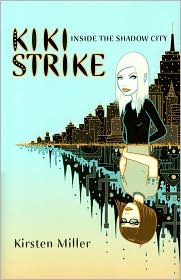 Five delinguent Girl Scouts, a million hunrey rats, one secret city beneath Manhattan, and a butt-kicking girl superspy--welcome to the world of Kiki Strike.
Catchy, no?
When I was 11 or 12, I adored The Three Investigators series. Kiki roused grinning memories of those stories--covert hideouts, practical detecting tips, and a league of smart, under-estimated, crime-fighting teenagers who rely on their own brains over technology.
I love the way Kirsten Miller doesn't slouch on even the smallest aspects of her story. Random example: the narrator's grandfather put his entire fortune in a trust fund for his descendants' education, to save them from the life of the idle rich. Her parents, however, ended up staying in school their entire lives, earning degrees and "accepting a few odd jobs here and there to cover the cost of food, clothing, and reading material." Such delicious tidbits make a story gleam.
It's the sort of book that has exact matches in readers: as I read, at least three people popped into my head who would devour the action and personalities that Miller delivers.
And there's another one! Kiki Strike: The Empress's Tomb. Hooray for sequels already in print!
All I Want for Christmas...

According to this website, they're only $55 per volume.
Well, come on, that is 22 karat gold on the accents. Good stuff ain't cheap.
Used Bookstore Nuggets
The day I left for Kiev, and the day after I got back, we visited a couple of used bookstores. I go a bit crazy when I get such chances, since there are absolutely no places to buy books, cheap or otherwise, anywhere near my town.
I used to dream of opening a used bookstore/cafe ... except that not many people read around here.
Anyway, here are my finds.





I used to dream of opening a used bookstore/cafe ... except that not many people read around here.
Anyway, here are my finds.
.
.
.
.
.
.
I actually did get every single Anne book, though they're not a matching set. I mean, I already own them, but what a great gift for under ten bucks! The Little House books, I only found four in really good condition, but I bought the first two online, so now we're good.
.
And broke.
Scoop of the e-e-evening: Impossible
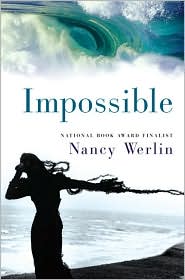 I’d read one or two ecstatic reviews of Nancy Werlin’s Impossible, but they were from readers whose tastes don’t always align with mine, and so I opened the book late one evening, expecting to skim a few pages and turn out the light.
You’ve heard that one before.
Lucy Scarborough is seventeen when she discovers that the women of her family have been cursed through the generations, forced to attempt three seemingly impossible tasks or to fall into madness upon their child's birth. But Lucy is the first girl who won't be alone as she tackles the list. She has her fiercely protective foster parents and her childhood friend Zach beside her. Do they have love and strength enough to overcome an age-old evil?
A story rooted in an age-old ballad has the potential to strike deep. You know the lyrics, have long ago accepted the events they chronicle, and are willing, wanting, and waiting to dissolve the haze that surrounds all legendary verse.
Scarborough Fair is already a haunting tune, and Werlin’s embroidery forms a vibrant history behind the words that ensures you will never hear the song again without thinking of this story.
Elements of fantasy are difficult to pull off in a realistic setting. Werlin succeeds quite well. I like this calm acceptance:
“It was also strange to realize that, even if her own particular nightmare was over, she now knew there was another world, close to theirs, a world of magic and curses and uncanny things, a world that was not rational. Lucy did not like to think about this, but there was no other conclusion to be drawn.”
How true is that? In our day, it’s “impossible” to believe in a world outside of logic, of science and provable fact. And yet, as Rodgers’ and Hammerstein’s fairy godmother sings, “Impossible things are happening every day.”
You Asked for Photos
Nanny Noel and her three charges
 Toilet stall doors at the Amsterdam airport
 St. Michael's
 Matryoshka dolls
 Replica of an old Russian church
 Playing the the leaves
 Me in Independence Square, seat of the Orange Revolution
 My room
 Our house in Kiev
 Food in Ukraine (that's milk in the white and blue bag)
 The market
Quotes from The Educated Imagination
 "...the creative and the neurotic minds have a lot in common. They're both dissatisfied with what they see; they both believe that something else ought to be there, and they try to pretend it is there or to make it be there."
"All writers are conventional.... For the serious mediocre writer convention makes him sound like a lot of other people; for the popular writer it gives him a formula he can exploit; for the serious good writer it releases his experiences or emotions from himself and incorporates them into literature, where they belong."
"We know nothing about Shakespeare except a signature or two, a few addresses, a will, a baptismal register, and the picture of a man who is clearly an idiot."
"Literature does not reflect life, but it doesn't escape or withdraw from life, either: it swallows it."
"What we'd never see except in a book is often what we go to books to find. Whatever is completely lifelike in literature is a bit of a laboratory specimen there. To bring anything really to life in literature we can't be lifelike: we have to be literature-like."
"It's important too that everything that has a story, such as a myth, should be read or listened to purely as a story. Many people grow up without really understanding the difference between imaginative and discursive writing. On the rare occasions when they encounter poems, or even pictures, they treat them exactly as though they were intended to be pieces of more or less disguised information. Their questions are all based on this assumption. What is he trying to get across? What am I supposed to get out of it? Why doesn't somebody explain it to me?"
Incidentally, C.S. Lewis has a fabulous essay where he touches on the cause behind this though-pattern. On a Description of the Times.
Trends in YA Literature
Sounds like a community college course.
I've just been weeding the stacks, making way for all the gorgeous books I've processed this year. Ever wonder what there was before Fantasy?
Ghost stories. I bet I've discarded thirty of the buggers.


 .
.
.
.
.
.
.

 .
..
.
.
.
.
.
How much longer does Fantasy have? What's next?
NBA Young Adult Finalists
 I've only read Frankie, but The Underneath is in my book bag, and Chains has been in the library's Amazon cart for a couple of weeks. Hadn't heard of the other two. Kind of an odd assortment, don't you think? Which one will win?
Cybils Hopes
 Cybils nominations are closed ... they'll post an official list on Monday, but I went ahead and scoured the comment pages for personal favorites. My hopes for the 2008 Cybils are:
Middle Grade Fiction
The Penderwicks on Gardam Street, by Jeanne Birdsall
Cosmic, by Frank Cottrell Boyce
Masterpiece, by Elise Broach
Young Adult Fiction
Trouble, by Gary Schmidt
Jellicoe Road, by Melina Marchetta
Fantasy/Science Fiction
Well Witched, by Frances Hardinge (which I read last year as Verdigris Deep)
The Adoration of Jenna Fox, by Mary Pearson
Noel's Runners-Up:
Impossible, by Nancy Werlin
The Hunger Games, by Suzanne Collins
Sweethearts, by Sara Zarr

Kidz Book Buzz Blog Tour: The Diamond of Darkhold, Day 3
 FREE BOOKS!
Er, book.
That's right, I'm giving away an ARC of Jeanne Du Prau's Diamond of Darkhold to one lucky reader.
All you have to do is this:
In the novel, several characters are named after famous "ancient" cities ... Scawgo, Washton, New Yorick. Evidently, the passing years weren't kind to the memories of these great places.
So your task is to rename yourself with a convoluted city-name from our past: Pears, Juicelum, you get the idea.
Robbie puts all entries into a hat, and the winning entry recieves The Diamond of Darkhold.
You have until midnight Friday. Let the games begin!
Subscribe to:
Posts (Atom)