Joel, KJV *
Jellicoe Road, by Melina Marchetta
The Deadlist Monster, by Jeff Baldwin
Hosea, KJV *
Heidi, by Joanna Spyri
Waiting for Normal, by Leslie Connor
Daniel, KJV *
Patron Saint of Butterflies, Cecilia Galante
Rapunzel's Revenge, Shannon & Dean Hale
Framed, by Frank Cottrell Boyce
Ezekiel, KJV *
Little Brother, by Cory Doctorow
Moby Dick, by Herman Melville*
Breaking Dawn, by Stephenie Meyer
*denotes a title I resolved to read this year

RE Writing
 I've spent the past couple of days rewriting the first three chapters of my novel.
From scratch.
The past two years, I've crossed out, erased and edited until I could nearly quote each line, but the roots I was tweaking were the wrong roots.
Now we're getting somewhere.
I never thought finding my stride would be this HARD!
Scoop of the e-e-evening: The Patron Saint of Butterflies
 I knew this would be a tough read. I knew it would make me uncomfortable, but I was counting on an overall positive gripping experience, and I'm not sure that's what I came away with.
Agnes and Honey have always been best friends, but they haven't always been so different. Agnes loves being a Believer. She knows the rules at the Mount Blessing religious commune are there to make her a better person.
Honey hates Mount Blessing and the control Emmanuel, their leader, has over her life. The only bright spot is the butterfly garden she's helping to build, and the journal of butterflies that she keeps.
When Agnes's grandmother makes an unexpected visit to the commune, she discovers a violent secret that the Believers are desperate to keep quiet. And when Agnes's little brother is seriously injured and Emmanuel refuses to send him to a hospital, Nana Pete takes the three children and escapes the commune.
The fact that the author drew on personal experience to write this novel is immense. It really adds a new dimension to the story. I told my mom I was reading a book by a woman who'd grown up in a religious commune, and she said, "Oh, you mean a cult?" Well, yeah. One freaky-fried cult.
My biggest problem with this novel is the way it tangles the already tangled web of religion. Tolerance is modern society's buzzword, so of course your average student knows about religious freaks. They understand that people do strange things for their beliefs. But reading a novel takes you down below head knowledge to the sticky realm of emotions and gut reactions.
A religious leader, calling himself Emmanuel, beats disobedient children. He calls it "retraining." Instant reflex: No! That's wrong! Agreed. But it's followed up with this line: "It's abuse, Agnes. There's no other way around it. And there is no such thing as retraining people, okay, darlin'? People are free to make up their own minds, not to be trained to think and act like seals."
Under the circumstances, how can anyone say they disagree with that argument? Readers have a bloody picture in their head, and a Christian who comes along with, "Well, technically, there is such a thing as retraining--but not like that!" will not be well received.
Each time I thought the author was moving in a more positive direction, about to show that the Believers were the exception to the rule, and there really is a true way out there, she got all fuzzy on me. "Love is the answer," the preacher continues. "If we love one another, then we need not fear anything else. Love--" he raised the Bible in the air-- "is everything."
Honey asks Agnes: "Have you ever tried to trust yourself to do the right thing? Instead of always waiting for some sign or trying to figure out what Emmanuel thinks is right for you?"
In the context of the story, your reaction is, "Yes! Stop relying on Emmanuel. Trust yourself!" But if modern psychology has shown us anything, it's shown us that we're the last beings in the universe we want to trust. Man is downright unreliable. Yet we're supposed to follow our hearts? Believe that if we love one another, everything will turn out all right?
That's the worst kind of fairy tale you can feed a child.
Heroes: Natalie Babbitt
 How do I love thee? Let me count the ways.
Tuck Everlasting Doomed to--or blessed with--eternal life after drinking from a magic spring, the Tuck family wanders about trying to live as inconspicuously and comfortably as they can. When ten-year old Winnie Foster stumbles on their secret, the Tucks take her home and explain why living forever at one age is less a blessing that it might seem.
The Eyes of the Amaryllis When the brig Amaryllis was swallowed in a hurricane, the captain and all the crew were swallowed, too. For thirty years the captain’s widow, Geneva Reade, has waited, certain that her husband will send her a message from the bottom of the sea. But someone else is waiting, too, and watching her, a man called Seward. Into this haunted situation comes Jenny, the widow’s granddaughter. The three of them, Gran, Jenny, and Seward, are drawn into a kind of deadly game with one another and with the sea, a game that only the sea knows how to win.
Scoop of the e-e-evening: Waiting for Normal
 The bad thing about hype is that it usually lets you down. I'd heard exciting reviews of Waiting for Normal, but in the end, it turned out to be pretty run-of-the-mill.
Addie is waiting for normal. But Addie's mom has an all-or-nothing approach to life: a food fiesta or an empty pantry, jubilation or gloom, her way or no way. All or nothing never adds up to normal. All or nothing can't bring you all to home, which is exactly where Addie longs to be, with her half sisters, every day. In spite of life's twists and turns, Addie remains optimistic. Someday, maybe, she'll find normal.
Waiting for Normal reminded me of last year's A Crooked Kind of Perfect: the odds are stacked against our small-town heroine, but she reaches down and pulls through. Actually, that describes about 1.356 million middle-grade novels, but hey, you know what I mean. It had a similar flavor.
I'm getting tired of the same old cast: 1 (one) resilient girl, 1 (one) character who dies (preferably of cancer), 1 (one) dysfunctional parent, 1 (one) wild card. In this case, the variable is a really nice guy who happens to have a boyfriend, but that's no big deal and never raises any concerns.
These stories typically get pre-award-season buzz, but when all is said and read, they blur together.
Define "Slightly"
 I’ve been happy with "slightly abridged" versions of Eva Ibbotson’s work before. The Star of Kazan is superb on CD, despite the warning that it’s slightly abridged.
So picture my fury at picking up a hard copy of The Dragonfly Pool and sticking in my earbuds with a fancy to compare the two, only to realize that this time, some editor was way out of line.
Enter angry eyes.


Forget everything I said about The Dragonfly Pool being meh. Evidently, the novel I listened to was the diet, caffeine-free, off-brand version. I’m reserving judgment til I taste the real Eva Ibbotson.
Grr.
Scoop of the e-e-evening: Framed
 I am an official Boyce fan. I loved this book. It was immense. It was so much fun. If you're world-weary, weighted down by stacks of bleak YA fiction, turn on your heel this very moment and snag a copy of Framed.
From the publisher:
A few things to know about Dylan. He is the only boy in his entire town—so forget about playing soccer. His best friends are two pet chickens. His family owns the world's only gas station/coffee house—their pies are to die for, but profits are in the hole. Criminal instincts run in his family—his sister is a mastermind-in-training, and the tax men are after his father for questioning. And one more small thing about nine-year-old Dylan—the crime of the century has just fallen into his lap.
With the same easy mix of wit, warmth, and wonder that made his debut novel, Millions, an award-winning international bestseller, Frank Cottrell Boyce tells the story of a boy who reminds an entire town of the power of art.
I just can't praise Boyce enough. He doesn't try to be clever--he is clever. He writes a story rooted in art--fine art!--that appeals to junior high boys. They won't even notice they're getting into paintings. Maybe Frank isn't clever--maybe he's a genius.
"It's a laughy book, isn't it?" said Robbie, walking past where I sat on the sofa, laughing out loud as I read. (He snagged it before I could.) It is. And your brain requires a "laughy" book every now and then. One with lines like,
It was a picture, a picture of a woman trying to read a book. The woman's face was in color, but her clothes were in black and white and the top of her head was missing. The most random thing though was that one of her boobies was sticking out of her dress, like you sometimes see on the front of the papers. I looked at Dad. Lester looked at both of us, then he said, "The Manchester Madonna." "Right," I said and looked at Dad again. It didn't look like Madonna to me.
"How come he's never heard of the Turtles?" said Tom. "Is he thick or what?"
"Your mam is short of money. The paintings up there are worth millions. We could nick one and swap it for one of these." He had three [paint by numbers] pictures to choose from. One was of a collie dog. One was of an alpine scene. One was a vase of flowers. I suddenly remembered that Nice Tom used to be called Daft Tom.
 To top it all off, Dylan's dad owns a mini cooper. Have I ever told you that minis are my ultimate, number one, favorite car? Seriously, books don't get much better than this.
Heroes: Dorothy Sayers
 How do I love thee? Let me count the ways. My favorites are the Lord Peter/Harriet Vane combos:
Strong Poison Dorothy Sayers's Lord Peter Wimsey ranks among the world's great fictional detectives. In this story he joins forces for the first time with the one true love of his life, Harriet Vane, who is on trial for poisoning her fiancé when Wimsey meets her. Not only does Wimsey believe in her innocence, he falls in love with her at first sight. Cleverly he brings home the case for her.
Have His Carcase The mystery writer Harriet Vane, recovering from an unhappy love affair and its aftermath, seeks solace on a barren beach -- deserted but for the body of a bearded young man with his throat cut. From the moment she photographs the corpse, which soon disappears with the tide, she is puzzled by a mystery that might have been suicide, murder or a political plot. With the appearance of her dear friend Lord Peter Wimsey, she finds a reason for detective pursuit -- as only the two of them can pursue it.
Gaudy Night When Harriet Vane attends her Oxford reunion, known as the "Gaudy," the prim academic setting is haunted by a rash of bizarre pranks: scrawled obsentities, burnt effigies and poison-pen letters -- including one that says, "Ask your boyfriend with the title if he likes arsenic in his soup." Some of the notes threaten murder; all are perfectly ghastly; yet in spite of their scurrilous nature, all are perfectly worded. And Harriet finds herself ensnared in a nightmare of romance and terror, with only the tiniest shreds of clues to challenge her powers of detection, and those of her paramour, Lord Peter Wimsey.
I'm up at NovelJourney today...
 ... interviewing the amazing Jeanne Birdsall! Anyone who cites Gaudy Night, The Enchanted Castle, Knight's Castle, Ballet Shoes, and The Secret Garden among their top 14 favorite books is the author for me!
Scoop of the e-e-evening: Little Brother
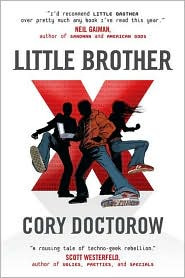 “A rousing tale of techno-geek rebellion,” Scott Westerfield praises. And techno-geek is right.
 Before reading Doctorow’s novel, I considered myself fairly competent in the technology department. Two pages into the book, however, my idea of computer nerd was blown out of the water. Compared to Little Brother’s hero, Marcus, my brain is … a turd.
Am I the only one who is completely paranoid about computers after finishing this book? How can you not, after reading passages like: “Botnets are where infected computers spend their afterlives. When you get a worm or a virus, your computer sends a message to a chat channel on IRC—the Internet Relay Chat. That message tells the botmaster—the guy who deployed the worm—that the computer in there is ready to do his bidding.”
.Marcus is the kind of guy who observes, “Knowing how to turn a toilet paper roll and three bucks’ worth of parts into a camera-detector is just good sense.”
He builds his own laptops, for crying out loud. Apparently people actually do this. “If you’ve never programmed a computer, you should. There’s nothing like it in the whole world …. It’s awesome in the truest sense: it can fill you with awe.”
There is a ton of fun, fun, really cool stuff in this book—LARPing, crypto, arphid jamming. However. My brother started reading Little Brother before I’d finished, and was totally getting into it, when I came upon a few scenes that made me swipe the book out of his hands. Why, oh why did Doctorow have to throw in episodes involving the phrase “horn-dog”? Not stuff a 15-year-old needs to be feeding his imagination. I’m sure there are thousands of people who will roll their eyes and say, “Please. You’re such a prude. There are much worse things out there.” Maybe. But why build up to them? Why encourage thoughts about, say, unsnapping a girl’s bra?
Then there’s this theme: “I don’t know how to know who to trust, but I know who not to trust: old people. Our parents. Grown-ups …. Back in the day, they used to say, “Never trust anyone over 30.” I say, “Don’t trust any b…..d over 25!”
I’m sorry, but that so does not swing for me.
The Afterwords and Bibliography, at least, are interesting, and sexless, though, as far as controversial ideas go, they demand vigilant reading, just like the rest of Doctorow’s novel. Written by a security technologist and “the” X-box hacker, Little Brother’s afterwords really made me laugh. Only techno-geeks write lines like, “Hackers are explorers, digital pioneers” and “I was just following a natural impulse, the same impulse that leads to fixing a broken ipod.”
The main theme of Little Brother is obvious. “…no matter how unpredictable the future may be, we don’t win freedom through security systems, cryptology, interrogations and spot searches. We win freedom by having the courage and the conviction to live every day freely and to act as a free society, no matter how great the threats are on the horizon.”
Marcus quotes this passage from the Constitution several times: “…it is the right of the people to alter or abolish [the government], and to institute new government, laying its foundations on such principles, and organizing its powers in such form, as to them shall seem most likely to effect their Safety and Happiness."
"As to them shall seem most likely to effect their Safety and Happiness." I think the deists must have put that in. ;) Pretty open-ended for an age where people stretch every limit. Doctorow banks his entire novel on that section.
Freedom is a powerful word, an important word, packed with meaning and interpreted a bit differently by each set of glasses people's beliefs supply. Doctorow’s techno-geek specs tint his vision a bit too anarchist for me. “So close the book and go,” instructs the security technologist in the first afterword. “The world is full of security systems. Hack one of them.”*
Marcus fights for freedom. Our country’s forefathers fought for liberty. There’s a difference. Contrary to popular belief, we are not the gods of our own destiny. Not everything is about what seems best for us. Proverbs 14:12 is a good reminder: "There is a way which seemeth right unto a man, but the end thereof are the ways of death."
*Context: In order to strengthen security, it must be tested, tweaked, and made stronger. But is that the best mindset to promote among the masses??
When I Should be Listening to the Sermon ...
 I think of all the church scenes that feature my favorite heroines.
Emily Starr: It was fascinating to study those varied faces, and speculate on the histories written in mysterious hieroglyphics over them. They had all their inner, secret lives, those men and women, known to no one but themselves and God. Others could guess at them, and Emily loved this game of guessing....
Kit Tyler: Bother these people! Look at Judith, sitting there with her hands folded in her lap. Didn't her feet ever go to sleep? Nevertheless, if this were a test of endurance, then he could see it through as well as these New Englanders. She tilted she chin so that one plume swept gracefully against her cheek, discreetly curled and uncurled her numb toes inside the kid slippers, and set herself to endure.
Anna Grazinsky: "Therefore if any man can show any just cause why they may not lawfully be joined together" ...
"Stop! Oh, stop! This marriage must not be!" ... "It must not be," repeated Dr. Lightbody, his pale eyes glittering now with a Messianic fever. He brushed aside the Lady Lavinia, reached the alter rails: "This lovely woman has been most hideously deceived!"
The vicar blinked. In her pew, the dowager, who had read Jane Eyre no less than seven times, shook her head in disbelief.
Signs of a Literary Household?
My sister put a note on the toilet ...
Out Of (M)Ordor
Draw your own conclusions.
Out Of (M)Ordor
Draw your own conclusions.
8 songs on my ipod in the 8th month of '08
 A while back, Erin memeed 7 songs she was into at the moment. Since my reading has been trickling, I thought I might as well post about music. (Note: Don't watch, just listen. Some visuals ruin a song.)
1) Be My Escape, reliant k
2) Viva la Vida, Coldplay
3) The Funeral, Band of Horses
4) Ageless Beauty, Stars
5) On Fire, Switchfoot
6) The Kiss, Penelope soundtrack
7) There She Goes, The La's
8) Blame, Transluzent
The Twilight Saga: Final Verdict
It’s not been a cheerful week in Meyer-land. All across America, readers—especially young ones—are agonized by the author’s final installment in her bestselling Twilight saga. Publishers Weekly sums up the disgruntlement:
“Essentially, everyone gets everything they want, even if their desires necessitate an about-face in characterization or the messy introduction of some back story. Nobody has to renounce anything or suffer more than temporarily—in other words, grandeur is out. This isn’t about happy endings; it’s about gratification. A sign of the times?”
I very much enjoyed Ms. Meyer’s first three novels—with the Darcy-ish knowledge that I liked them against my better judgment. Good vampires? Please, Noel. You’re all about spurning the inversion of traditional archetypes. “The meanings of symbols are not merely the capricious choices of a limited culture,” remember? (Michael O’Brien, A Landscape With Dragons)
Still, Stephenie Meyer was spinning a good tale, and she had me hooked. Then along came Breaking Dawn.
As a story, Breaking Dawn is much weaker than the saga’s initial novels. I won’t go into detail—just visit any fan site, read almost any Amazon review, and you’ll hear all about the “travesties” Stephenie committed against her characters. None of them made the story stronger.
According to her website, Stephenie didn’t envision Twilight as a YA book, but it turned out to have tremendous “kid appeal” despite that fact. Breaking Dawn, however, is Adult Fiction through and through. No wonder all her 6th grade fans are upset. The attraction is gone.
And though I’m past 6th grade, the attraction is gone for me, too.
A friend and I discussed our reactions after finishing the series, and I was reminded of all the moral elements I’ve been ignoring.
How far would you go for something alluring enough?
How valuable is an eternal soul?
According to Stephenie, it’s worth trading in for Edward Cullen.
Then there’s the Mormon factor. I received a comment on one of my Meyer posts a while back, from a Mormon reader who didn’t think Stephenie’s faith affected the books—they were just good, clean stories. I’m sorry, but no one functions outside a worldview, no matter what they’re doing—shopping for groceries or writing fiction. Stephenie’s Mormon beliefs bleed onto her pages, just as my Christian beliefs bleed into this post.
The similarities—up to a point—between the Twilight saga and The Little Mermaid are interesting. Also Romeo and Juliet, but that’s old news. The distinguishing variation in both cases is the resolution. And that is where Stephenie’s worldview diverges from the classic model that Shakespeare and Anderson (among millions of others) embodied. Michael O’Brien, in his Disney-bashing chapter, includes this:
“In order to obtain her desire (marriage to a land-based human prince), [the little mermaid] swims away from home and makes a pact with an evil Sea Witch, who turns her into a human for three days, long enough to make the prince kiss her. If she can entice him to do so, she will remain human forever and marry him.
"So far, the film is close to Hans Christian Anderson’s original fairy story. But a radical departure is to be found in the way the plot resolves itself. Despite the disasters the little mermaid causes, only other people suffer the consequences of the wrong she has done, and in the end she gets everything she wants. Charming as she is, she is really a selfish brat whose only abiding impulse is a shallow romantic passion.
"In the original Anderson tale, the little mermaid faces some difficult moral decisions and decides for the good, choosing in the end to sacrifice her own desires so that the prince will remain happily married to his human bride.”
The net result of this heavy-handed editing, says O’Brien, is that “the meaning of the story is seriously distorted, even reversed …. You can play with evil and get away with it, maybe even be rewarded for your daring by hooking the handsomest guy in the land, winning for yourself your own palace, your own kingdom, and happiness on your own terms.”
Sound familiar, Twilighters?
“Essentially, everyone gets everything they want, even if their desires necessitate an about-face in characterization or the messy introduction of some back story. Nobody has to renounce anything or suffer more than temporarily—in other words, grandeur is out. This isn’t about happy endings; it’s about gratification. A sign of the times?”
I very much enjoyed Ms. Meyer’s first three novels—with the Darcy-ish knowledge that I liked them against my better judgment. Good vampires? Please, Noel. You’re all about spurning the inversion of traditional archetypes. “The meanings of symbols are not merely the capricious choices of a limited culture,” remember? (Michael O’Brien, A Landscape With Dragons)
Still, Stephenie Meyer was spinning a good tale, and she had me hooked. Then along came Breaking Dawn.
As a story, Breaking Dawn is much weaker than the saga’s initial novels. I won’t go into detail—just visit any fan site, read almost any Amazon review, and you’ll hear all about the “travesties” Stephenie committed against her characters. None of them made the story stronger.
According to her website, Stephenie didn’t envision Twilight as a YA book, but it turned out to have tremendous “kid appeal” despite that fact. Breaking Dawn, however, is Adult Fiction through and through. No wonder all her 6th grade fans are upset. The attraction is gone.
And though I’m past 6th grade, the attraction is gone for me, too.
A friend and I discussed our reactions after finishing the series, and I was reminded of all the moral elements I’ve been ignoring.
How far would you go for something alluring enough?
How valuable is an eternal soul?
According to Stephenie, it’s worth trading in for Edward Cullen.
Then there’s the Mormon factor. I received a comment on one of my Meyer posts a while back, from a Mormon reader who didn’t think Stephenie’s faith affected the books—they were just good, clean stories. I’m sorry, but no one functions outside a worldview, no matter what they’re doing—shopping for groceries or writing fiction. Stephenie’s Mormon beliefs bleed onto her pages, just as my Christian beliefs bleed into this post.
The similarities—up to a point—between the Twilight saga and The Little Mermaid are interesting. Also Romeo and Juliet, but that’s old news. The distinguishing variation in both cases is the resolution. And that is where Stephenie’s worldview diverges from the classic model that Shakespeare and Anderson (among millions of others) embodied. Michael O’Brien, in his Disney-bashing chapter, includes this:
“In order to obtain her desire (marriage to a land-based human prince), [the little mermaid] swims away from home and makes a pact with an evil Sea Witch, who turns her into a human for three days, long enough to make the prince kiss her. If she can entice him to do so, she will remain human forever and marry him.
"So far, the film is close to Hans Christian Anderson’s original fairy story. But a radical departure is to be found in the way the plot resolves itself. Despite the disasters the little mermaid causes, only other people suffer the consequences of the wrong she has done, and in the end she gets everything she wants. Charming as she is, she is really a selfish brat whose only abiding impulse is a shallow romantic passion.
"In the original Anderson tale, the little mermaid faces some difficult moral decisions and decides for the good, choosing in the end to sacrifice her own desires so that the prince will remain happily married to his human bride.”
The net result of this heavy-handed editing, says O’Brien, is that “the meaning of the story is seriously distorted, even reversed …. You can play with evil and get away with it, maybe even be rewarded for your daring by hooking the handsomest guy in the land, winning for yourself your own palace, your own kingdom, and happiness on your own terms.”
Sound familiar, Twilighters?
Small Town Girl
 Just how small is my town?
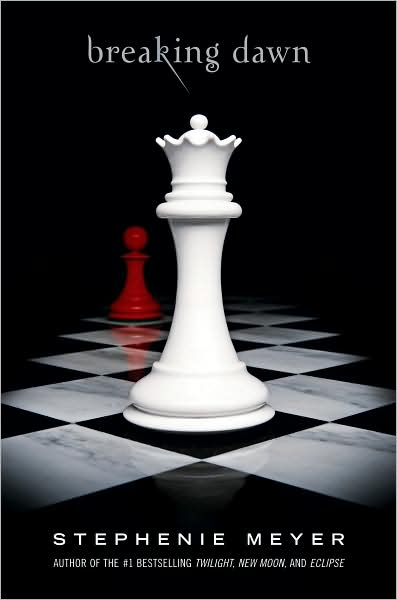
Before work this morning, I ran to Wal-Mart, the closest/only place to snag a couple of copies of Breaking Dawn. (Most libraries use Baker and Taylor … we’re odd.)
I walked in: no sign of breathless girls, screaming over their new Stephenie Meyer. In fact, no sign of the new Stephenie Meyer at all. When I asked where I might find Breaking Dawn, the associate gave me a blank stare. “What’s that?”
“A book. A new book that came out today.”
She shrugged and went to inquire of the manager, who went to rummage in the “back,” and who finally emerged triumphant with a copy of Breaking Dawn!
“Oh,” I apologized, “I should have told you, I need two copies. They’re for the public library.”
She disappeared again, and a few minutes later appeared with another book. “You’re in luck,” she told me, smiling. “We bought two copies.”
Needless to say, that made me laugh pretty hard inside. Two whole copies for an entire town! :)Lucky me.
Cousin Camp '08: A Midsummer Night's Dream
Every summer, the eleven De Vries cousins get together and make a movie. Our biggest productions have been The Lion, the Witch and the Wardrobe and Twelfth Night. This year, we put on A Midsummer Night's Dream, with a Mexican twist. (That's Marie all the way to the right) 
Distributing the t-shirts. They read: "We Make Our Own Movies" and on the back, "What fools these [cousins] be!" 
Peaseblossom
 Titania's changeling boy
Oberon taking a siesta

Peaseblossom
 Titania's changeling boy
Oberon taking a siesta

Bottom and Titania 
The lovely Thisbe
Peter Quince, The Wall, Pyramus
Helena
Robbie liking Puck's wig
 Hippolyta and Theseus
Lysander and his future father-in-law

The lovely Thisbe

Peter Quince, The Wall, Pyramus

Helena

Robbie liking Puck's wig
 Hippolyta and Theseus
Lysander and his future father-in-law
 Demetrius and Hermia
A scene from the forest

Subscribe to:
Posts (Atom)