*Indicates a book I resolved to read this year
May Reading Log

Dickinson Friday: 154

Except to Heaven, she is nought.
Except for Angels — lone.
Except to some wide-wandering Bee
A flower superfluous blown.
Except for winds — provincial.
Except by Butterflies
Unnoticed as a single dew
That on the Acre lies.
The smallest Housewife in the grass,
Yet take her from the Lawn
And somebody has lost the face
That made Existence — Home!
Russian 101
I'm honing my skills, listening to one of those CDs that enable you to "Learn [Insert Language] In Just 40 Minutes!". Want a sample?
Bring me.
Bring me please.
Bring me please beer.
Yep, I'll be wearing that one out.
Bring me.
Bring me please.
Bring me please beer.
Yep, I'll be wearing that one out.
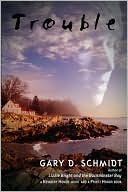
Scoop of the e-e-evening: Trouble
 "Some books are to be tasted, others to be swallowed, and some few to be chewed and digested: that is, some books are to be read only in parts, others to be read, but not curiously, and some few to be read wholly, and with diligence and attention." -Sir Francis Bacon
When you come across a book that requires chewing and digestion, you must sample it in small doses—nobody rushes a box of Godiva chocolates. To read a book wholly, you must give it your whole attention, but any extra diligence is amply repaid in the pure, premium experience of reading a Really Good Book.
Henry Smith’s father told him that if you build your house far enough away from Trouble, then Trouble will never find you. But Trouble comes careening down the road one night in the form of a pickup truck that strikes Henry’s older brother, Franklin. In the truck is Chay Chouan, a young Cambodian from
From the description, I expected Henry’s climb to take up most of the story, but Schmidt doesn’t hurry anything that deserves our whole attention. He knows how to handle a box of chocolates, and makes every page worth turning.
Example. How to Paint Character in One Line or Less: He was Franklin Smith, O Franklin Smith, the great lord of us all, Franklin Smith.
Characters that waver between main and supporting are difficult, but Schmidt creates the perfect best friend in
Scenes that anyone else would have botched—teary-eyed, father-son heart-to-heart?—Schmidt welds into the story’s backbone.
“Henry,” he said. “Henry, do you think
Henry was so startled, he took a step back.
“I know,” said his father. “How can anybody ask that? But lately, it’s the only question I seem to be able to ask. Not: Why was
Everything about this story is well done. As in, well done, good and faithful servant. It isn’t a quick read, or an easy read, but it is a book to chew, digest, and murmur, Well done!
So There's This Girl...
.jpg)
And Tolstoy is on her ipod for months. She grows to love the Rostov family ... Moscow ... the holy images. And two weeks after she finishes War and Peace, she gets an offer to go to Russia. As a nanny. Expenses paid. Two weeks (at least) in Sumy. And she says YES!
Heroes: Eva Ibbotson
 How do I love thee? Let me count the ways.
The Star of Kazan. Ibbotson, known for ghost-and-witches tales, produced a glowing sport when she wrote Kazan, a novel worthy to be compared with The Secret Garden. Beautifully-written and delightfully-plotted, it's replete with long-lost mothers, Russian jewels, gypsies, castles, despicable villains, Lipizzaner stallions and unforgettable characters. Its virtual obscurity is a disgrace. Circulate this story among all the children you know--but read it yourself, first!
A Countess Below Stairs. This is a curl-up story about a Russian girl whose family must flee their homeland during the Revolution of 1917. In England, Anna hires herself out as a maid to the household of Lord Rupert, a young man just released from an army hospital. The characters who inhabit their neighborhood are a delight. Yes, plot lines are somewhat fudgy, but A Countess Below Stairs is a fairy-tale you can't help loving.
Dickinson Friday: 167
 To learn the Transport by the Pain
As Blind Men learn the sun!
To die of thirst — suspecting
That Brooks in Meadows run!
To stay the homesick — homesick feet
Upon a foreign shore —
Haunted by native lands, the while —
And blue — beloved air!
This is the Sovereign Anguish!
This — the signal woe!
These are the patient "Laureates"
Whose voices — trained — below —
Ascend in ceaseless Carol —
Inaudible, indeed,
To us — the duller scholars
Of the Mysterious Bard!
Scoop of the e-e-evening: The Adoration of Jenna Fox
 Wow.
Wow.Outside first. Just holding this book, you know you have something good. Its dimensions are smaller than most hardcovers. A beautiful kind of small. Not old-book small, but almost.
Now inside.
Seventeen-year-old Jenna has been told that is her name. she has just awoken from a year-long coma, and she’s still recovering from the terrible accident that caused it. Her parents show her home movies of her life, her memories, but she has no recollection. Is she really the same girl she sees on the screen? Little by little, Jenna begins to remember. Along with the memories come questions—questions no one wants to answer for her. What really happened after the accident?
The writing was much sparser than I expected. But it only took a few pages and I forgot my discomfort. I was in.
Books you are certain of rereading before you’re even halfway through are so far between. Mary Pearson delivers such a book.
Books with a true, hearty laugh-out-loud moment are hard to find. Pearson delivers the paragon of moments with a mistaken vocabulary word.
And she can write. “Silence threads though the house like a lace pulling tight.”
Did I mention she seamlessly weaves a future world, replete with unaltered life, and replete with change, without once sounding like a conspiracy theorist? Always just the right amount of progress and “progress.”
The epilogue was slightly dissatisfying, but I think that’s because it confirmed the novel’s inevitable bittersweet qualities. One thing readers won’t run short of is passages for discussion!
Things that weaken most writing only enhance Pearson’s. For example, she doesn’t flesh out Jenna’s old friends. They are names, and not much else. Your mind begins to dismiss them as stock characters and then you stop. You stop and realize that Jenna feels the same distance, the same emptiness of color, background and endearment. She, too, is missing the million pieces that knit friends into our hearts.
Another example. Very few authors can pose enormous philosophical questions without sounding pompous and obvious. Pearson creates a girl who knows nothing—of self, of human interaction, of mortality—and suddenly, enormous philosophical questions are vital. The reader soaks them in. “The question that twists inside me again and again—am I enough?—I realize for the first time, is not just my question, but was the old Jenna’s question as well.”
It is everyone’s question. We all wonder at the weight of a sparrow.
Prince Caspian
 Two words: smash hit.
We die-hard Narnia fans might not have a cool name (though "Narnighters" is an option), but when it comes to fierce passion for The Books, we're there. We want faithful adaptions just as much as the next reader and frankly, the Prince Caspian trailer should be burned. It gave fans like me zero hope for a good movie. I mean, seriously, when Ben says "I am Prince Caspian" in that my-name-is-Inigo-Montoya voice, how can you not smash your forehead into the keyboard?
But it was all a set up. Because the movie is such the best.
Yes, the plot was shuffled like cars on a rush hour board, and yes, there is an out-of-nowhere assault on Miraz's castle, and yes, there is a slight romance between Caspian and Susan. However, in my opinion, Prince Caspian, as a film, is better than The Lion, the Witch and the Wardrobe. Heresy? Go see the movie.
The pacing is much better. The beach locations are amazing. The comic relief is not so corny. The entire Telemarine flavor is delicious. It is a grounded world, it is true to the essence of the novel, and what's more, Adamson kept lines. DLF, oh bother, must I sit on your head? Very satisfying.
If you're interested, visit this site for documented proof of the De Vries Family Narnia Obsession.
Dickinson Friday: 393
 Did Our Best Moment last —
'Twould supersede the Heaven —
A few — and they by Risk — procure —
So this Sort — are not given —
Except as stimulants — in
Cases of Despair —
Or Stupor — The Reserve —
These Heavenly Moments are —
A Grant of the Divine —
That Certain as it Comes —
Withdraws — and leaves the dazzled Soul
In her unfurnished Rooms
.
(This poem reminds me of "the flash" that Emily of New Moon encountered.)
Classic Math




I finished War and Peace! (Not the "acclaimed new translation," unfortunately, but you have to start somewhere.) My favorite character is Marya. My favorite quote is this:
.
In the past he had never been able to find that great inscrutable infinite something. He had only felt that it must exist somewhere and had looked for it. In everything near and comprehensible he had only what was limited, petty, commonplace, and senseless. He had equipped himself with a mental telescope and looked into remote space, where petty worldliness hiding itself in misty distance had seemed to him great and infinite merely because it was not clearly seen. And such had European life, politics, Freemasonry, philosophy, and philanthropy seemed to him. But even then, at moments of weakness as he had accounted them, his mind had penetrated to those distances and he had there seen the same pettiness, worldliness, and senselessness. Now, however, he had learned to see the great, eternal, and infinite in everything, and therefore--to see it and enjoy its contemplation--he naturally threw away the telescope through which he had till now gazed over men's heads, and gladly regarded the ever-changing, eternally great, unfathomable, and infinite life around him. And the closer he looked the more tranquil and happy he became. That dreadful question, "What for?" which had formerly destroyed all his mental edifices, no longer existed for him. To that question, "What for?" a simple answer was now always ready in his soul: "Because there is a God, that God without whose will not one hair falls from a man's head."
Heroes: Edward Eager
Half Magic Mark, Katherine, Jane, and Martha discover a magic coin which only grants half wishes - the children end up half invisible (and rather ghost-like) and half on a desert island (which is, of course, just a desert), and have many more adventures with the magic coin.
Magic by the Lake On vacation, those same four children find themselves with an entire lake full of magic, which they must tame and learn how to handle in order to find the treasure that waits for them.
Knight's Castle Cousins Roger, Ann, Eliza, and Jack have an extraordinary summer when, after an old toy soldier comes to life, they find themselves transported back to the days of Robin and Ivanhoe.
Time Garden Those same four cousins spend a summer in a house by the sea and discover a magic thyme garden from which they embark on a number of adventures back and forth through time.
Eager began writing children's stories when searching for books to read to his young son. Enough said. Or maybe not--in each book he carefully acknowledges his indebtedness to E. Nesbit, whom he considered the best children's writer of all time--"so that any child who likes my books and doesn't know hers may be led back to the master of us all." Now enough said.
Dickinson Friday: 1129
 Tell all the Truth but tell it slant —
Success in Circuit lies
Too bright for our infirm Delight
The Truth's superb surprise
As Lightning to the Children eased
With explanation kind
The Truth must dazzle gradually
Or every man be blind —
Birdsall Interview
Check out this interview with Jeanne Birdsall, author of the delightful Penderwicks on Gardam Street.
Scoop of the e-e-evening: The Penderwicks on Gardam Street
 The Penderwicks on Gardam Street is the perfect title for Jeanne Birdsall’s sequel to her National Book Award-winning debut, The Penderwicks. The story radiates a lovely sense of community and comfortable, neighborly warmth. I read The Penderwicks with interest, seeing in it a pleasant departure back to the innocent novels written fifty years ago. It was a refreshing novelty, but not great. With this sequel, however, Birdsall has produced a shining gem.
 .
.
Just the right sort of book to read together on cool, Spring mornings.
Camp Narnia Update
 Planning is underway … we’ll read from the novel, roast apples over a fire, watch an archery professional demonstrate bow and arrows, play blind man’s bluff and hide the slipper, learn about the constellations, make bark rubbings from several dryads—I mean, trees—and give away the official movie companion. Off to a good start … any more Prince Caspian-related suggestions?
 Scoop of the e-e-evening: The Sea of Monsters
 Reviewed by my 14 y/o brother, Robbie.
The Sea of Monsters begins on the last day of school for Percy Jackson. Strangely enough, there haven’t been any monster attacks the entire school year. Percy feels that this is going to be the first year he hasn’t been kicked out of school. But by the end of the day, he’s changed his mind.
A tree protecting Camp Half-Blood’s borders has been poisoned, and as it dies, the camp is in danger of being overrun by monsters—unless the “golden fleece” can be found and brought to Camp Half-Blood. Percy, Annabeth and a newly-found friend must journey through the dangers of the Sea of Monsters, known to us as the Bermuda Triangle. What with guinea pigs, confederate warships and the cruiser Princess Andromeda, filled with demons and traitorous half-bloods, Percy’s chances of succeeding in his quest are slim. However, courage and assistance from several unexpected sources help Percy and Annabeth bring the golden fleece back to camp. But does the magic work too well?
Book 2 in a series.

Heroes: E. Nesbit
 How do I love thee? Let me count the ways.
The Enchanted Castle An invisible princess, a magic ring, and more adventures than you could dream of. This is what Gerald, Kathleen and Jimmy find when they stumble upon a mysterious castle. At first it all appears to be a lark. But the children soon discover they need all their bravery and ingenuity to contend with the castle's supernatural forces.
The Railway Children When their father is sent away to prison, three London children move to the country where they keep busy preventing accidents on the nearby railway, making many new friends, and generally learning a good deal about themselves.
The Story of the Treasure Seekers When their father's business fails, the six Bastable children decide to restore the family fortunes. But although they think of many ingenious ways to do so, their well-meant efforts are either more fun than profitable, or lead to trouble — until one adventure has quite unexpected results. Sequels include The Would-Be-Goods and The New Treasure Seekers.
Five Children and It Before the children had had no idea that there was such a thing as a sand-fairy, now they were talking to "It". They discovered the odd-looking, cranky creature while digging. The fairy grants them a wish a day, lasting until sunset, but the wishes don't always work as they should. Sequels include The Phoenix and the Carpet and The Story of the Amulet.
This is an super-cool article about (among other things) Nesbit's influence on C.S. Lewis. Bet you didn't know she wrote a story called The Aunt and Amabel about a little girl who climbs into a spare room wardrobe and is transported to another world.
Scoop of the e-e-evening: An Abundance of Katherines
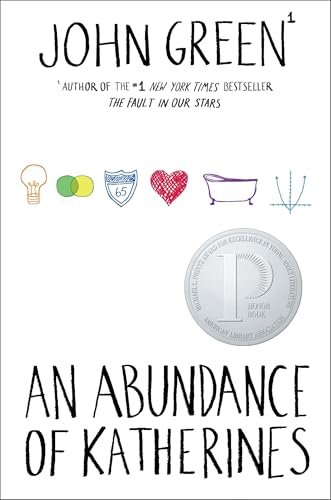 Bindy Mackenzie would be quite pleased with the way John Green cleans up his foxglove Printz-honor novel--just substitute "fug" each time that Other word comes to mind (every two paragraphs) and voila! a fairly decent read.
When it comes to relationships, Colin Singleton's type happens to be girls named Katherine. And when it comes to girls named Katherine, Colin is always getting dumped. Nineteen times, to be exact. He's also a washed-up child prodigy with ten thousand dollars in his pocket, a passion for anagrams, and an overweight, Judge Judy-obsessed best friend. Colin's on a mission to prove The Theorem of Underlying Katherine Predictability, which will predict the future of all relationships, transform him from a fading prodigy into a true genius, and finally win him the girl.
It's a different kind of book ... an intellectual yet "authentic" YA (hence the Printz) full of quirky footnotes, anagrams, mathematical equations and one surprisingly meaty conclusion: stories are what make life meaningful. I found it intriguing to watch a guy handle love scenes, especially after just finishing a Sarah Dessen novel. Absolutely no description, all short, random dialogue and columns of ellipses. As in, they're in a dark cave, and they're not talking ... Interesting.
An Abundance of Katherines was definitely not my normal cup of tea, but then, Green's fanclub hardly needs my membership. He's such a god among YouTubers and readers alike, my apathy won't even be noticed.
Scoop of the e-e-evening: This Lullaby
 This Lullaby was my maiden Sarah Dessen voyage (gasp! chuzzle! choke!) and I truly enjoyed the story, despite several differences in opinion with her characters re: sex, alcohol and risque photographs. (Can it be healthy to imbibe that much beer?)
When it comes to relationships, Remy doesn't mess around. After all, she's learned all there is to know from her mother, who's currently working on husband number five. But there's something about Dexter that seems to defy all of Remy's rules. He certainly doesn't seem like Mr. Right. For some reason, however, Remy just can't seem to shake him. Could it be that Remy's starting to understand what those love songs are all about?
I am a lot like Remy--not the bitchy part--just seriously in need of loosening up. Dessen does a wonderful job showing the joie de vive that Dexter brings to Remy's clinical existence. Too often I walk through life without taking my eyes off some marker in the distance, all the while missing the millions of joyful moments that lap at my feet.
Dessen's characters are lively, funny and real ... but the sad truth that last adjective reveals is a youth culture of lonely, fatherless, bed-and-bar-hopping pessimists who yearn for fresh beginnings. They don't understand that the answer isn't found in new surroundings--the change must take place in their hearts.
Dickinson Friday: 449
 I died for Beauty — but was scarce
Adjusted in the Tomb
When One who died for Truth, was lain
In an adjoining room —
He questioned softly "Why I failed"?
"For Beauty", I replied —
"And I — for Truth — Themself are One —
We Brethren, are", He said —
And so, as Kinsmen, met a Night —
We talked between the Rooms —
Until the Moss had reached our lips —
And covered up — our names —
Subscribe to:
Posts (Atom)