April Reading Log

  • Peeled, by Joan Bauer
  • The Man Who Was Thursday, by G.K. Chesterton *
  • Sweethearts, by Sara Zarr
  • An Abundance of Katherines, by John Green
  • Just Listen, by Sarah Dessen
  • This Lullaby, by Sarah Dessen
  • A Break with Charity, by Ann Rinaldi
  • The Scarlet Letter, by Nathaniel Hawthorne *
  • The Willoughbys, by Lois Lowry
  • Emma Watson, by Joan Aiken
  • Mansfield Revisited, by Joan Aiken
  • Five Minute Marriage, by Joan Aiken
  • Melusine, by Lynne Reid Banks
  • .

    * Denotes a title I resolved to read this year

    Scoop of the e-e-evening: Peeled

    It’s not easy to give thumbs down when you’ve just met the author of a book, just listened to them speak for two hours, just laughed until your sides hurt and cried a little, too. But you’re not a real reviewer if all you do is bubble.

    Hildy Biddle is a high school reporter eager to stand up for the truth. She’s just waiting for a chance to prove herself as a journalist, and yearning for a big story. The trouble is, the town’s biggest story stars … a ghost. Not a very easy interview! This ghost has the town in a tizzy, and the local paper is playing up people’s fears with shocking headlines of eerie happenings and ghostly sightings. Hildy’s determined to discover what’s really going on, but her desire to uncover the truth is making some people awfully nervous.

    Well. The cover is a triumph. It’s amazing. It pops. Unfortunately, the inside doesn’t measure up. Bauer’s cast is extensive, and it’s difficult to flesh out such a large gathering of characters. Hildy’s family—Mom, Uncle Felix, cousin Elizabeth (ha ha), Nan—her school friends—Darrell, Lev, T.R., Tanisha, Zach—these people are rarely more than names. For a story to last in your mind, strong relationships are essential, and Peeled never quite delivers the required depth. A lot happens in a limited number of pages, and Bauer relies a bit too heavily on her trademark one-liners. A few are brilliant, but even brilliance is dimmed with overuse.

    To be sure, there are plenty of fifth-grade girls who will enjoy reading Peeled. It’s not completely devoid of good points, whatever cranky reviewers may say. :) But if you’re choosing between “the new Joan Bauer” and a lovely reissue of Thwonk, Squashed, or Backwater, go for the paperbacks.

    Shakespeare Can Be Fun!

    But working with third graders is hairy. I've been going over Lois Burdett's script for A Midsummer Night's Dream, in preparation for the annual Cousin Drama Camp in June. (Ten cousins, ranging from 3 to 21 ... we're never short on drama, let me tell you.) Last year's Twelfth Night was amazingly fun and easy, so we opted to tackle another comedy, albeit a comedy that requires someone to wear a burro pinata on his head (yes, we're giving it a Mexican flare, inspired by the culture-jumping in Branagh's As You Like It. Forget Greece.).
    Once again, Shakespeare has written a play with half as many female parts as our family demands, but the girls will just have to stick on their beards and deal with it. I know. I'm such a Peter Quince. But somebody has to be the one screaming, "Quiet! 3-2-1 ..."

    Check Out This Jammy Site!


    .
    A guy reading Twilight. Priceless. A homeschool grad and contracted children's author, no less. How can you not love that expression?
    .

    Happy Poetry Month!

    Never on painter’s canvas lives
    The charm of his fancy’s dream.
    .
    ~Unknown

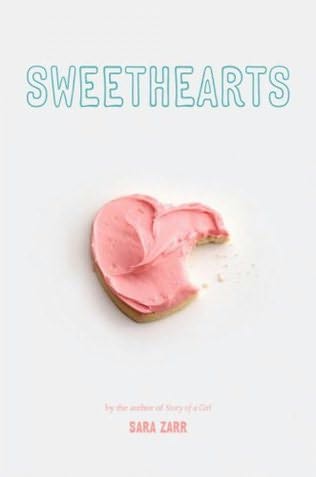
    Scoop of the e-e-evening: Sweethearts

    Every now and then, I see it coming. The mail shows up on a busy afternoon and I know there’s no chance of reading before bedtime, but the book … I stare at it, accepting the knowledge that I’ll finish the book before morning, despite the promise of an enormous reading hangover, despite the understanding that all-nighters cramp some of the story’s potency. It must, and will, be read. Tonight. So it was no surprise to find myself closing the final page of Sara Zarr’s Sweethearts at 1 am—I saw it coming.

    From the jacket flap: (Easy way out, yes, but remember the reading hangover? It’s here.) As children, Jennifer Harris and Cameron Quick were both social outcasts. They were also one another's only friend. So when Cameron disappears without warning, Jennifer thinks she's lost the only person who will ever understand her. Now in high school, Jennifer has been transformed. Known as Jenna, she's popular, happy, and dating, everything "Jennifer" couldn't be---but she still can't shake the memory of her long-lost friend. When Cameron suddenly reappears, they are both confronted with memories of their shared past and the drastically different paths their lives have taken.

    Some people cannot stomach Roman Holiday. I mean, he doesn’t get the girl, so what’s the point of the last hour and a half, what’s the point of two people finding each other, learning to love each other, if they’re not going to ride off into the sunset? If you’re one of those people, you’ll dislike Sweethearts. (Yeah, yeah, send me your anti-spoiler hate mail. Whatever.)

    There’s a poignancy to the novel, a reminder that life isn’t just about tomorrow. Pascal wrote, “The past and the present are our means, the future alone our end. Thus we never actually live, but hope to live, and since we are always planning to be happy, it is inevitable that we should never be so." I remember the first time I saw Roman Holiday … I was dumbfounded. And then I slowly came to realize that the very reason this story would stay with me, swim around my head, refuse to drop out of sight like so many happily-ever-after films, the very reason this story was different was its determination to actually live.

    In so much fiction, “the future alone” is the characters’ end goal. Books and movies often allow characters to reach that future point right before the lights cut, ignoring the impossibilities of their attainment. But in real life, and in the best stories, we’re reminded that we are surrounded by unfinished business, and always will be. However, at the same time we’re reminded that sometimes the unfinished business is love.

    I'm Up at NovelJourney Today

    Check out my interview with Joan Bauer. (I just happened to have a photo for this post ;)

    P.S.

    I totally forgot one important observation by Chip MacGregor. He has a theory I find verrrry interesting:

    The reason there are almost no successful writers in their twenties is that MFA programs are stifling original voice. College grads are all taught to write in the same manner, and it takes several years for them to rediscover themselves.

    It's lovely to hear another person--a man in authority--posit this. I had the same theory when I was making the decision to skip university and study writing and lit on my own. It wasn't an easy choice, but already I'm seeing the positive effects. 1) I've finished the first draft of a novel. What college student has time to write a novel? 2) I read for pleasure 24/7, classics and current hits. What college student has time to read? 3) I have a job as a children's librarian, and can save money, rather than dig myself into debt. What a head start on life!

    I could go on. But I'll end with the swirling muse, maybe all the people who shook their heads when I didn't go to college will someday be reading a unique voice to their children ... who knows?

    Festival Notes, Saturday

    Well. Sorry about last night ... we were watching I Capture the Castle until midnight. When you have six younger siblings, opportunities for peacefully renting an R-rated movie don't come around very often.

    But anyway.

    Yesterday morning we heard Randy Testa of Walden Media speak on "C.S. Lewis and the Moral Imagination." Good stuff--not much I hadn't heard before from On Three Ways, but good stuff, nonetheless.

    Moral agency in the world through fantasy

    Fantasy imbues reality with new dimensions of depth

    Fantasy helps kids make sense of reality

    Then I sat in the same room with Kadir Nelson and Carole Boston Weatherford and listened to them talk about historical fiction.

    Jeffrey Overstreet gave a lovely presentation entitled, The Eagles are Coming: Faith, Fairy Tales and Fantasy. Anyone who once heard and chokes up talking about Madeleine L'Engle is, as far as I'm concerned, of the race of Joseph.

    We attended an amazing performance of poetry spoken and sung ... an a cappella choir in tuxes and black dresses, singing the words of Emily Dickinson and e.e. cummings and Dylan Thomas. Beyond description. Not to mention Katherine Paterson was sitting a few rows over.

    And then Yann Martel, author of The Life of Pi, which I freely admit to not having read, spoke last night. While he and I differ theologically (majorly), I love this idea. You've probably heard of it, but, wow, so cool.

    Fast forward to today, Saturday, bleary-eyed but excited to hear the likes of Joan Bauer.

    I had no idea she'd be so wonderful. I mean, yes, when you're fourteen and reading Hope Was Here for the first time, Joan is All That. But as time goes by, you move on to other heroes. She's certainly back on the list, however. What an energetic speaker--and so very, very gracious. Her frank and emphatic Christianity surprised me, I must say, despite having read all her books. An encouragement to all those who wish to let truth and beauty, rather than Elsie Dinsmore, declare the glory of God in their writing.

    In order to make characters real, you must get stuck.

    Our writing is like a geyser ... a geyser happens when everything below ground is going wrong. Yet the end result is an amazing thing of beauty.

    As people lined up to speak with Joan afterward, I read the name tag of the ordinary lady behind me ... "Nikki Grimes." Strangely familiar. OH! (cue Beauty and the Beast music) Could it be? Is it she? Nikki Grimes! I was on celebrity watch the rest of the day. :)

    Okay, then I heard a solid practical session from Chip MacGregor, including bits like "The Big Secret to Selling Your Novel: Become a Great Writer."

    So it's late and mom is glaring at the sound of typing ... I'll skip around and wrap up with the last session of the weekend, Katherine Paterson on beauty. She read from Bread and Roses, Too, waving her arms and using a broad Italian accent, superb, the scene that gives the book its title ... we want more than bread. We want some sort of something beautiful for our beautiful children. She quoted Schiller, saying that beauty is achieved through play. And then she dismissed the festival by encouraging writers to return home, not bogged down by a heavy sense of needing to create big, beautiful Art, but to go home and play.

    And that, as Gary Schmidt's grandmother would apparently say, that will do.

    Happy Poetry Month!


    A song is but a little thing,
    And yet what joy it is to sing!
    In hours of toil it gives me zest,
    And when at eve I long for rest;
    When cows come home along the bars,
    And in the fold I hear the bell,
    As Night, the shepherd, herds his stars,
    I sing my song, and all is well.
    .
    There are no ears to hear my lays,
    No lips to lift a word of praise;
    But still, with faith unfaltering,
    I live and laugh and love and sing.
    What matters yon unheeding throng?
    They cannot feel my spirit's spell,
    Since life is sweet and love is long,
    I sing my song, and all is well.
    .
    My days are never days of ease;
    I till my ground and prune my trees.
    When ripened gold is all the plain,
    I put my sickle to the grain.
    I labor hard, and toil and sweat,
    While others dream within the dell;
    But even while my brow is wet,
    I sing my song, and all is well.
    .
    Sometimes the sun, unkindly hot,
    My garden makes a desert spot;
    Sometimes a blight upon the tree
    Takes all my fruit away from me;
    And then with throes of bitter pain
    Rebellious passions rise and swell;
    But -- life is more than fruit or grain,
    And so I sing, and all is well.
    Paul Laurence Dunbar

    Festival Notes, Thursday

    Mind the mess...


    Here are the main ideas and thoughts I took away from Gary Schmidt's "Writing for the Middle School Reader: War, Trouble and Calamity."

    Decisions

    What decisions do we make to turn away from childhood and turn toward adulthood?

    Our culture perpetuates adolescence because adolescents are good consumers

    Evidence: wasteland medium of television, adults refusing to take responsibility, to admit mistakes

    Adults send kids the message they shouldn't want adolescence to end

    We live in a messy world, decisions are rarely simple

    YA books should not be about adulthood, but about turning toward adulthood ... about overcoming ... trying to understand who the hero is ... and story should be first

    We understand through stories

    St. Augustine on the purpose of story: Should story be beautiful? Yes. Should story be well-crafted? Yes. Should it convey wisdom? Yes. But if you ask these first, you miss the point. Our first question should be, does the story serve. Does it bring joy and laughter, knowledge, understanding, does the reader grow.

    After hearing Michael Chabon, I'm interested in The Yiddish Policeman's Union. Anyone read it?


    Oh, guess who else I saw (besides Alm Uncle)? Mark Bertram. Noticed him from across an auditorium. Not that he has any idea of my existence, any more than Mr. Schmidt does, but it's fun to spot familiar faces, and force your mother to admit that the people you spend all this time talking about really do exist outside the Internet!

    And now I'm ready to crash. But I have time for one incredibly embarrassing story that all you emotionally detached people will probably find hilarious: So it's late tonight, quarter to ten, and my mom and I are walking out of a poetry reading. We pass the doors to the coffee break area, and glimpse people and food. My mom wants a cup of coffee, so we detour. Only when our plates are full of crackers, cheese, strawberries and chocolate do the lights dim, and a man stand up to thank everyone for their support as Friends of the Festival. Cue two red-faced women backing toward the door. Croopus, I will never forget the look on my mother's face. I'm sure she'll remember mine! But why didn't anyone stop us from walking in??? Ah, c'est la vie.

    And Now, LIVE From Grand Rapids, MI...


    I'm here! Basking in thirty minutes of quiet until it's time to hear Michael Chabon on Imaginary Homelands.

    Gary Schmidt was wonderful, very inspiring. He spoke smoothly and calmly, shuffling his feet every few seconds, but voice and face composed. He read a few pages from The Wednesday Wars, and the audience was totally wrapped around his little finger. Amazing.

    I'll post my messy notes later tonight.

    But one more thing, guess who else showed up? The organist at vespers is Alm Uncle in the flesh. An enormous pipe organ dominated the chapel, and here is this solid old man, with a flowing white beard, putting his entire heart and soul into the music. Lovely.

    Brad Pitt and ... Chasing Vermeer?

    Blue Balliett has a new book out, The Calder Game, and apparently Chasing Vermeer is in pre-production with none other than Brad Pitt's company, Plan B Entertainment. I immediately had no hopes for the film, but then I saw the director's name: PJ Hogan, who did the very cool live-action Peter Pan a few years back. Now I'm thinking, this could be good.

    Scoop of the e-e-evening: The Lightning Thief

    The Lightning Thief
    by Rick Riordan

    Reviewed by my 14 y/o brother, Robbie

    Percy Jackson was a half-blood. He grew up believing that his dad was some rich guy that hadn’t been able to marry his mom because his relations wouldn’t have allowed it. And then, before Percy was born, his dad had gone on an ocean voyage and been lost at sea. Not dead, just lost. But when his math teacher turns into a Fury, and his best friend turns out to be a satyr, Percy starts wondering who his dad really is.

    .

    After being attacked by a Minotaur, Percy is forced to go to Camp Half-Blood, a camp where all of the demigods stay the summer and train for combat with monsters. It’s there that Percy’s father claims him. It turns out that Percy is the only son of Poseidon, and Poseidon isn’t supposed to have any children. But when Zeus’ Master Bolt is stolen and Poseidon is blamed, Percy has to go on a journey to the Underworld to retrieve the Master Bolt, and prevent a world war.

    .

    Percy takes two companions with him on his quest, Annabeth, daughter of Athena, and Grover, Percy’s best friend, a satyr that plays Hilary Duff songs on his reed pipe. But once he gets to the Underworld, Percy realizes that he’s been tricked. Now it’s a race to get out of Hades and to Mount Olympus (the 600th floor of the Empire State Building) with the Master Bolt before the summer solstice is over.

    .

    This book had me on the edge of my seat the entire time. I read it in an afternoon and I am now waiting impatiently for Noel to get the second book in the series, The Sea of Monsters.

    Happy Poetry Month!

    They Had No Poet, by Don Marquis

    “Vain was the chief’s, the sage’s pride!
    They had no poet and they died.” — POPE.

    By Tigris, or the streams of Ind,
    Ere Colchis rose, or Babylon,
    Forgotten empires dreamed and sinned,
    Setting tall towns against the dawn.

    Which, when the proud Sun smote upon,
    Flashed fire for fire and pride for pride;
    Their names were . . . Ask oblivion! . .
    “They had no poet, and they died.”

    Queens, dusk of hair and tawny-skinned,
    That loll where fellow leopards fawn . . .
    Their hearts are dust before the wind,
    Their loves, that shook the world, are wan!

    Passion is mighty . . . but, anon,
    Strong Death has Romance for his bride;
    Their legends . . . Ask oblivion! . . .
    “They had no poet, and they died.”

    Heroes, the braggart trumps that dinned
    Their futile triumphs, monarch, pawn,
    Wild tribesmen, kingdoms disciplined,
    Passed like a whirlwind and were gone;

    They built with bronze and gold and brawn,
    The inner Vision still denied;
    Their conquests . . . Ask oblivion! . . .
    “They had no poet, and they died.”

    Dumb oracles, and priests withdrawn,
    Was it but flesh they deified?
    Their gods were . . . Ask oblivion! . . .
    “They had no poet, and they died.”

    Scoop of the e-e-evening: The Willoughbys

    Sometimes you need ice cream. One-third of the way through The Willoughbys, I was feeling disappointed. There was no meat. By the end, however, things were coming together, and I was enjoying the story as it was meant to be enjoyed—as an ice cream sundae.

    I am not a Lemony Snicket fan, and the story at first seemed to emulate his aimless style. Parents disappear, nanny appears, pointless episodes ensue. But as Lowry’s story progressed, the episodes took shape and twined into a fairly coherent plot with a definite conclusion, something no Snicket book ever pretended to possess.

    Timothy, twins Barnaby A and Barnaby B, and little Jane are rather old-fashioned children, and their parents are less than charming. In fact, on the same day the children feel the urge to become old-fashioned orphans, their parents formulate a plan to make them so.

    There are some funny lines:

    An American boy whose mother proudly believes he can speak German: “Itz that better, Mutti?” Neits und schtright?” “You know I don’t speak German, dear,” she replied.

    When that same boy comes back from Switzerland, wearing traditional Swiss garb, Tim murmurs, “It’s Peter the goat-herd, right out of Heidi! We can teach him to read and write, and then we’ll all smile and hug and say religious things!”

    While most of the literary references are spelled out—a delicious, “Don’t be such an Oliver” is half-spoiled by an explanation of Oliver Twist—I noticed one reference that Lowry dropped with only a sly smile: “Her name is Ruth.” Jane pouted. “Why?” she asked. “Because,” Tim said with a sly smile, “we are the ruthless Willoughbys.” Fifty points if you know what book that quote is from.

    All in all, The Willoughbys is a nice, old-fashioned alternative for kids who enjoy the light humor of a Lemony Snicket, without the utter pointlessness of his plots.

    Scoop of the e-e-evening: Wildwood Dancing

    Wildwood Dancing

    By Juliet Marillier

    .

    (Reviewed by my 14 y/o brother, Robbie, whose reading tastes vary from David Copperfield to Nancy Drew to Swallows and Amazons. He’s kind of like Mikey in those old Life cereal commercials … he’ll try anything, and his approval is worth noting.)

    .

    I thoroughly enjoyed Wildwood Dancing. From the beginning of this book till the end I was enthralled. The story is a retelling of The Twelve Dancing Princesses, a fairy tale of twelve sisters who travel to an enchanted kingdom every night and dance until dawn, only then returning to their father’s castle through a magical portal.

    .

    Juliet Marillier reduced the number of sisters to five, and the number of visits to the “Other Kingdom” to one a month. On the night of Full Moon, the sisters lock themselves into their room and open the portal by casting the shadows of their hands upon the wall. They’ve been going to the Other Kingdom for nine years, and no one except the second sister, Jenica’s, pet frog, Gogu, knows their secret. But when their father becomes ill and must leave for the clearer air of the seaside, and their power-hungry cousin Cezar decides to take over her home, Jenica must fight to keep her beloved friends from the Other Kingdom safe. While Jenica is struggling for her home, her eldest sister, Tatiana, is distracted from all her duties by her love for Sorrow, a man from the Other Kingdom and possibly one of the mysterious Night People.

    .

    The book had just the right amount of fairy tale mixed in with reality. It was a very good book that deserves to be read more than once.
    Eldritch

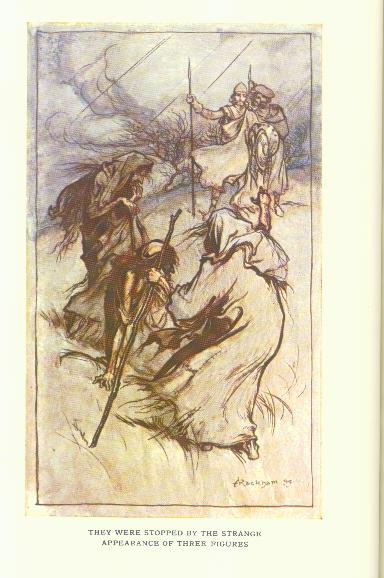
    Three times in one week I've come across the word "eldritch." Joan Aiken used it twice, and Hawthorne drops it in The Scarlet Letter. Join me in discovering the definition of an archaic adjective:
    .
    Eldritch: eerie; weird; spooky.
    .
    Origin: 1500–10; earlier elrich, equiv. to OE el- foreign, strange, uncanny + rīce kingdom; hence “of a strange country, pertaining to the Otherworld”; cf. OE ellende in a foreign land, exiled (c. G Elend penury, distress), Runic Norse alja-markir foreigner.

    Suggesting the operation of supernatural influences; "an eldritch screech"; "the three weird sisters"; "stumps...had uncanny shapes as of monstrous creatures"- John Galsworthy; "an unearthly light"; "he could hear the unearthly scream of some curlew piercing the din"- Henry Kingsley.

    Happy Poetry Month!


    Inside this pencil
    crouch words that have never been written
    never been spoken
    never been taught

    they’re hiding

    they’re awake in there
    dark in the dark
    hearing us
    but they won’t come out
    not for love not for time not for fire

    even when the dark has worn away
    they’ll still be there
    hiding in the air
    multitudes in days to come may walk through them
    breathe them
    be none the wiser

    what script can it be
    that they won’t unroll
    in what language
    would I recognize it
    would I be able to follow it
    to make out the real names
    of everything

    maybe there aren’t
    many
    it could be that there’s only one word
    and it’s all we need
    it’s here in this pencil

    every pencil in the world
    is like this

    -W.S. Merwin

    Festival Rumblings

    I've been looking over my session options for the upcoming Festival of Faith and Writing at Calvin College. Some of the highlights are...

    Writing for the Middle-School Reader: War, Trouble, and Calamity

    Gary Schmidt

    In a time of war and unrest, the writer for middle-school and young-adult readers is called to speak in ways that encourage those readers to survey a world realistically and openly, no matter what the genre, no matter what the form.

    .

    Reading to "Become"

    Jon J Muth

    In writing stories, we invite others to feel the world in the same way we do. In reading stories, we participate in a powerful conjuring experience. When these actions are considered in relation to children, there is an added profundity and an important responsibility. It's important that kids read to "become," not just to escape. Muth talks about how he tries to help kids do this through his own work.

    .

    C. S. Lewis and the Moral Imagination

    Randy Testa

    This session explores C. S. Lewis's opinions on the role of fantasy literature—including the Chronicles of Narnia books—in the moral education of children. Using passages from Lewis's essay "On Three Ways of Writing for Children" and clips from the forthcoming film Prince Caspian, Testa sheds light on the potential connection between fantasy and morality in the lives of children.

    .

    Not to mention Katherine Paterson and Joan Bauer! Should be exciting!

    Scoop of the e-e-evening: A Curse Dark as Gold

    Anticipation is hard on a book. You wait and wait for publication, your impatience builds, and inevitably, you're more excited when the postman arrives than when the final page is turned. Anticipation considered, A Curse Dark as Gold held up pretty well.

    Charlotte Miller is the last of a long line of Millers who have poured their sweat and blood into Stirwaters Mill. She's determined to continue providing for the townspeople who depend on the mill for their livelihood, no matter what it costs her personally. But Stirwaters Mill has a mind of its own, and when matters look their worst, Charlotte must turn to a stranger for help, and decide just where her treasure lies.

    Bunce does a wonderful job keeping tension consistent throughout the story. From the very first page, there's conflict, and it never lags. The writing is fluid and expressive ... the villagers' dialogue is wonderfully reminiscent of Joan Aiken ... the story is deeper than it appears on the surface. It's what I might call an epic fairy tale--really fleshed out.

    My partner in crime (14 y/o brother) who also read Curse says it's a good book, but you can tell it's a first novel. The implication of that statement is encouraging, however--so much more to look forward to from Elizabeth Bunce in the future.


    EC: Read an interview I did with Elizabeth over at Novel Journey last month.

    What is Walden Thinking?

    Star cameos are rather pathetic when they're squeezed in, despite having no place in the original script. And Tilda Swinton's White Witch certainly has no place in Walden Media's upcoming third installment of the Narnia films, The Voyage of the Dawn Treader.

    *sigh* They did such a nice job with the first movie. Well, ah, me. You can't win them all.