The Murder of Bindy Mackenzie, by Jaclyn Moriarty
A Crooked Kind of Perfect, by Linda Urban
Leap of Faith, by Kimberly Bradley
The Year of Secret Assignments, by Jaclyn Moriarty
Hang a Thousand Trees with Ribbons, by Ann Rinaldi
The Rising Star of Rusty Nail, by Lesley M.M. Blume
The Moonstone, by Wilkie Collins
Death of a Village, by M.C. Beaton
Howl's Moving Castle, by Dianna Wynne Jones
Absolutely True Diary of a Part-Time Indian, by Sherman Alexie
Sun and Moon, Ice and Snow, by Jessica Day George
Spell Book of Listen Taylor, by Jaclyn Moriarty

Leapy Day
 Today is a leapy sort of day. I typed the final words of my first draft! Hooray, hooray, hooray!
Of course, the whole thing is in desperate need of a bath, shave, manicure, pedicure, floss, brush, trim and Macy’s gift card, but the bones are there! Every single bone!
The closest I’ve ever gotten to this was 9th grade, where I spent the whole year writing a Novel. I had an English text that walked me through outlining, character development, conflict, climax, the whole shebang. For some reason, however, I never finished the last chapter of that story. Somewhere among my files are eleven of twelve Sylvia’s Journal chapters, destined to eternal obscurity.
The Jonah Bottle has been knocking around in my brain, under several names, since 2005, way back when I still kept a journal. I found this written on August 4th of that year: “My book ideas are shaping up … I’ve chosen names. Perhaps I’ll keep them, perhaps not. Donald, Lily and Frank Touser. Can’t tell if I like them or abhor them.”
2005 is where the brook and river met for me. I began to think less of writing Literature, more of writing stories for the enjoyment of myself and my siblings. I wrote this that August, too: “Jeanne Birdsall, the one who recommended Edward Eager, said, “I promised myself … that I’d become a writer someday, to give readers like me a few more books to discover and enjoy.” The question of the century: Strive after Art? Or be content to give readers a few more books to discover and enjoy.
From time to time I’ve begun stories for the kids, with the above quote as my guiding light. Think Nesbit, Eager, Enright. But can I be content with that? Or will the thirst for Utopia persist?”
Okay, I was a pretentious something or other. Too much Emily of New Moon at a young age. But the point is, I made the choice, I finished a story I’ve been brewing for two and a half years, and I enjoyed every tortuous minute. I am content.
Let the editing begin!
Dickinson Friday: 773

Deprived of other Banquet,
I entertained Myself —
At first — a scant nutrition —
An insufficient Loaf —
.But grown by slender addings
To so esteemed a size
'Tis sumptuous enough for me —
And almost to suffice
.A Robin's famine able —
Red Pilgrim, He and I —
A Berry from our table
Reserve — for charity —
Penelope
 I've been waiting forever to see Penelope, and it's finally coming out this weekend.
James McAvoy, folks. With or without the accent, he's worth the ticket. (Though they did give him a really bad nose job in Narnia...)
In case you're wondering--
Penelope Wilhern, born to wealthy socialites, is afflicted by the Wilhern spell that can only be broken when she finds love. Hidden away in her family's estate, the lonely girl meets a string of suitors in her parent's futile attempt to break the curse. Each eligible bachelor is enamored with Penelope and her sizable dowry... until her curse is revealed.
Lemon, a mischievous and eager tabloid reporter wants a photograph of the mysterious Penelope and hires Max to pose as a prospective suitor to get the shot. The handsome down-on-his luck gambler finds he falling for Penelope, but not wanting to disappoint her or to expose his surreptitious ways, he decides to disappear. Fed up by his latest betrayal and determined to live life on her own terms, Penelope breaks free from her family and ventures into the world alone. She finds adventure and Annie, her first friend and becomes the person she was meant to be.

And blah, blah, blah. But it looks really fun, and "modern day fairy tale" is right up my alley. Anybody wanna come with me?
Scoop of the e-e-evening: Hang a Thousand Trees with Ribbons
 Hang a Thousand Trees with Ribbons
By Ann Rinaldi
There are certain historical figures who dominate the spotlight—how many novels have been written about Shakespeare, for example? And then there are those figures who exist in the general memory, but vaguely, without any spark of energy. Phyllis Wheatley is one of those people.
You’d think there would be more attention given to the first black woman to publish original poetry, but I’ve not seen any other novels besides Ann Rinaldi’s. However, when you have Hang a Thousand Trees with Ribbons, you really don’t need anything else.
I’ve always wanted to write an intense novel about Emily Dickinson, and the way Rinaldi handles Phyllis’s story is exactly how I would love to treat Dickinson’s. Her writing is superb, just right for historical fiction of this type. She does a wonderful job putting flesh on a woman that no one knows very much about.
.
I was rather disappointed with her opinion of Phyllis’s poetry, however. Only a few lines are included in the novel, and Rinaldi’s endnote excuses this by saying Phyllis wrote in the style of her day, which was so overdone and flowery that no modern reader would enjoy it. Isn’t that sort of shooting yourself in the foot? Rinaldi breathes life into a forgotten heroine, and then dismisses the very accomplishments that brought her distinction. I thought that was rather odd, but since it’s in the author’s note, and not in the text itself, it shouldn’t affect your enjoyment of the story.
Scoop of the e-e-evening: The Mennyms
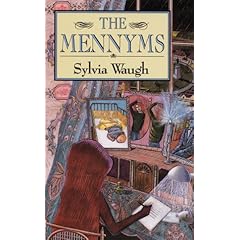 The Mennyms
By Sylvia Waugh
There are some books that have a peculiar charm because you read them as a child. You can reread them a dozen times and never get tired of the story. Other people hear you rave and raise one eyebrow, wondering if they’re missing something. The Mennyms is such a book.
The Mennynm family has lived in Brocklehurst Grove as long as anyone can remember. There’s Grandma, Granny Tulip, Joshua and Vanessa, and their five children, Appleby, Soobie, Poopie and Wimpie (twins) and baby Googles. (I wrote their names from memory, see?) Also Ms Quigley, who pretends to reside on Trafalgar Street, but really lives in the hall cupboard.
The Mennyms are not peculiar. They’re just a family of life-size rag dolls who have, by years of practice, learned to live alongside humans without attracting notice. They are quite good at being invisible, until one day, a letter arrives in the mail slot. A letter from their landlord’s nephew, who just inherited their house and would very much like to visit.
I could go on and on about this book. It’s lovely. Absolutely lovely. I mean, look at their names! Poopie and Wimpie? How can you not love this family? Their pretends—drinking “tea” every afternoon from empty cups, hauling out a cardboard turkey each Thanksgiving, lying on their beds each night with their button eyes staring up at the ceiling—their pretends only endear them more. Although The Mennyms is the first in a series of five, the first can stand alone, and I personally prefer it alone. (Waugh gets into some weird stuff in her later books, but perhaps it’s just because the first book was the only one I read for years and years.)
There is so much in this book—clever, clever wit, intrigue, ingenuity, characters that grab your heart and twist it. Remember You’ve Got Mail? Remember Kathleen’s voice when she tells Joe about Pride and Prejudice: “Ahh. Read it. You’ll love it.” That’s me right now, about The Mennyms.
I Did It!
 Hooray! I made it through a whole week without reading a single novel!
How does that make me Supergirl, and not Psychogirl?
Because I wrote over 15,000 words on my novel during those book-less hours, that's how. Plus, I got more sleep.
And guess what? My reading pile is still there, right beside my bed, so it looks like missing a week wasn't such a big deal, after all.
Can you see the evil look spreading over my face?
I dare you. I dare you to go a week without reading a novel. Do something big with all that extra time. Betcha can't.
(I think this is kind of like shaky nicotine gum-chewers taunting their smoker friends. I've been off fiction seven days, folks. Give me a break.)
Dickinson Friday: 320

We play at Paste—
Till qualified, for Pearl—
Then, drop the Paste—
And deem ourself a fool—
.
The Shapes—though—were similar—
And our new Hands
Learned Gem-Tactics—
Practicing Sands—
Reading meme
How can you resist a tag from someone who calls you Lady Noel? Someone who bought The Star of Kazan just because you told her to?
The Rules:
1. Pick up the nearest book (of at least 123 pages).
This was a hard one. I locked away all my novels this week, and put the key in Lucy's dog bowl, where she promptly ate it, despite the knowledge that lead poisoning is a dangerous illness, making my job of finding "the nearest book" quite an adventure. (Okay, so that was a Moriarty-ish rabbit trail, but I did have to get up from my chair.)
2. Open the book to page 123.
Check.
3. Find the fifth sentence.
Check.
4. Post the next three sentences.
Okay:
"Kay looked at him in blank surprise. "Who are you?" he asked.
"Naylor," said the giant, "John Naylor in the wide world it were, till us come to be a man of the 'ood."
Oh, man. I really really really really really want to keep reading. I've been dying to start T.H. White's The Sword in the Stone. I'm croaking here.
5. Tag five people.
Eh, let's skip that part. After all, I'm supposed to be writing right now, and coming up with five different friends would use too many little grey cells.
Cheers, Janet! I'm over 30k in my total word count!!
The Rules:
1. Pick up the nearest book (of at least 123 pages).
This was a hard one. I locked away all my novels this week, and put the key in Lucy's dog bowl, where she promptly ate it, despite the knowledge that lead poisoning is a dangerous illness, making my job of finding "the nearest book" quite an adventure. (Okay, so that was a Moriarty-ish rabbit trail, but I did have to get up from my chair.)
2. Open the book to page 123.
Check.
3. Find the fifth sentence.
Check.
4. Post the next three sentences.
Okay:
"Kay looked at him in blank surprise. "Who are you?" he asked.
"Naylor," said the giant, "John Naylor in the wide world it were, till us come to be a man of the 'ood."
Oh, man. I really really really really really want to keep reading. I've been dying to start T.H. White's The Sword in the Stone. I'm croaking here.
5. Tag five people.
Eh, let's skip that part. After all, I'm supposed to be writing right now, and coming up with five different friends would use too many little grey cells.
Cheers, Janet! I'm over 30k in my total word count!!
Statistics
 I've written 10k words this week.
Wow.
Especially considering that the past two years of brain storming produced about 15k words. In five days of tunneled dedication, I've almost doubled my word count.
After the initial excitement died down, I thought of something Stephenie Meyer said in an interview: "I used to read three or four books a week, but I can’t read while I’m writing. "
When I read that in December, I thought, "Croopus, that's a bummer. I'm glad that's not my groove."
But now it's looking like it is. Like I'm the most prolific when I cut out all distractions.
Ah, well, if the French can suffer to be beautiful, I suppose I can handle a little reading withdraw to be a writer. Just as long as this isn't a permanant situation. And considering how nicely I'm clipping along at the moment, the time for picking up books again can't be too far away.
I'm Up at NovelJourney Today
Read my interview with Sarah Miller, author of Miss Spitfire: Reaching Helen Keller.
No Reading

.
I'm proclaiming a week of no reading.
.
Before you wonder if I have suicidal tendencies, let me explain. I need to get some writing done. And the more I think about that quote from Writer magazine, the more I realize that I do cop out to read more often than I should.
.
And so, despite visions of Prince Rilian, bound and straining against his chair, I'm attempting a week without free reading. Who knows how much I'll get done on my book?
.
Besides, my dad can't call it an addiction anymore if I go a whole week without. I'll just keep my shaky hands under the dinner table.
Dickinson Friday: 604
 .
. Unto my Books -- so good to turn --
Far ends of tired Days --
It half endears the Abstinence --
And Pain -- is missed -- in Praise --
.
As Flavors -- cheer Retarded Guests
With Banquettings to be --
So Spices -- stimulate the time
Till my small Library --
.
It may be Wilderness -- without --
Far feet of failing Men --
But Holiday -- excludes the night --
And it is Bells -- within --
.
I thank these Kinsmen of the Shelf --
Their Countenances Kid
Enamor -- in Prospective --
And satisfy -- obtained --
And satisfy -- obtained --
.
Speaking of turning unto my books, the Cybils Award Winners were announced yesterday! Boo hoo for Leepike Ridge, but I am looking forward to reading the MG winner, A Crooked Kind of Perfect by Linda Urban. In fact, it's waiting for me at the library this very moment!
Post-Moriarty Brain Activity
 Which, if read quickly, could be mistaken for “post-mortem brain activity.”
It was one of those days. The shuffley kind, lacking any crumb of motivation, where you’re depressed from thinking about how depressed you are despite the fact that there’s no reason in the world to be depressed!
It’s February that does it. I bet a lot of Victorian women agreed to bad marriages in February, entirely because they had desperate urges for something to happen, and their kittens wouldn’t chase balls of yarn. What else could the poor things do? (The women, not the kittens.)
I know what I do. I go for a comfort book, and willingly waste the whole day rereading. Forget school, forget writing, forget taking a shower (kidding). Most of the time it’s The Blue Castle by L.M. Montgomery. But that’s only for genuine emergencies. Aimless, depressing, shuffley days call for something with a bit more speed. So I read Jaclyn Moriarty’s Year of Secret Assignments for the third time.
It’s one of those books where you wonder, “Is this just me? Do I have an abnormal fixation with this story, because I don’t see anyone else laughing out loud over their copy.” I think everyone has a book like that. A book that is there for you, and nobody else, but that’s okay, it gets the job done.
Not Pride and Prejudice. That one doesn’t count. People who go to Pride and Prejudice every time they’re out of ice cream are just reassuring their fantasies. It’s banging your head against a wall. I’m an Elizabeth and Darcy fan, but surely, the world has enough people quoting that book.
Of course, as soon as I felt better, the mail came and Writer magazine told me that writers who read while they write are hopeless losers. “For most blocked creatives, reading is an addiction. We gobble the words of others rather than digest our own thoughts and feelings, rather than cook up something of our own.”
Good thing I turned the page for the counterpoint “Trick of Reading the Right Things While Writing: Picking Relevant Material in the Formative Stages of Your Story Can Provide Inspiration and Information and Push You in New Directions.”
I choose … number two.
Croopus, the way people try and please everyone.
Well, I guess the day wasn’t a complete loss. I watched wacked and funny teenagers live happily ever after, laughed, wrote over four hundred words (though not on my novel), and had blackberry poppyseed dressing on my salad at dinner. Once again, Browning was right: God’s in his heaven, all’s right with the world. And February is halfway over.
Scoop of the e-e-evening: The Rising Star of Rusty Nail
 The Rising Star of Rusty Nail
By Lesley M. M. Blume
I’d heard good things about this story, and judging solely from the cover, it has a lot going for it (not to mention the author photo!). However, I just couldn’t settle down and enjoy the book.

Franny Hansen is a ten-year-old piano prodigy living in tiny Rusty Nail, where your business is everyone’s business. The town’s only music teacher has taken Franny as far as she can, however, and the budding pianist’s career seems doomed. Doomed, that is, until a mysterious Russian moves to Rusty Nail, with talent like Franny’s never seen.
Confession: I live in a small farm town. I’m surrounded by incarnate examples of Blume’s dialogue: “Her parents called me and tole me not to sell her any candy, so she don’t come in here no more.” I can only stomach so much country dialect, and Rising Star is replete with rustic phraseology. I know it’s all in fun, but at times the conversations read more like farce than anything. Blume paints some good images and keeps the action flowing, but in the end, “howdy-do” language is just not my cup of tea.
All in a Day’s Work …
There’s a woman using one of the library computers, talking on her mobile in a not-so-quiet whisper. Arguing with her boyfriend, who thinks she’s at some Other Guy’s house. She swears she’s not. “I’m at the library, dammit. You wanna talk to the librarian?” Please, please no. I do not want to testify in this court! Luckily, he hangs up. Her phone rings again. She answers softly and tenderly—not the boyfriend, I presume. “I’m at the library, but I’ll see you in a little bit.”
Geez. And people think librarians live under rocks.
Geez. And people think librarians live under rocks.
Dickinson Friday: 505

I would not paint--a picture--
I'd rather be the One
Its bright impossibility
Its bright impossibility
To dwell--delicious--on--
And wonder how the fingers feel
Whose rare--celestial--stir--
Evokes so sweet a Torment--
Such sumptuous--Despair--
.
I would not talk, like Cornets--
I'd rather be the One
Raised softly to the Ceilings--
And out, and easy on--
Through Villages of Ether--
Myself endued Balloon
By but a lip of Metal--
The pier to my Pontoon--
.
Nor would I be a Poet--
Its finer--own the Ear--
Enamored--impotent--content--
The License to revere,
A privilege so awful
What would the Dower be,
Had I the Art to stun myself
With Bolts of Melody!
.
.
It's been one of those weeks where I'd rather own the ear, rather be raised softly to the ceilings, than try and stun myself with bolts of melody. Writing is indeed an awful privilege!
Villanelle

Chrysalis
By Noel De Vries
A quiet body perches on the thorn,
Submitted to an arduous repose.
As gentle winds embrace its bulging form,
The larva's rigid crown is broken, torn
Until antennae sever and expose
A quiet body, perching on the thorn.
Convulsions burst upon the splintered horn,
Relent as outer separation slows,
And gentle winds embrace an empty form
Below a second figure, newly born.
Though cloven from itself, inside there grows
A quiet body, perching on the thorn,
Awaiting dawn, when golden light will warm
The tree. That morning comes! Beside a rose-
As gentle winds embrace its spreading form-
.
A Monarch flutters, jubilantly shorn
Of former skin and perishable clothes.
Its quiet body perches on a thorn
While gentle winds embrace the rippling form.
.
.
I wrote that when I was eighteen, and just came across it again today. The villanelle is a killer form, made famous by Dylan Thomas' Do not go gentle into that good night. Much worse than the terza rima bit I wrote while studying Dante. That was a good poem. I'll have to dig it up, too.
Scoop of the e-e-evening: The Absolutely True Diary of a Part-Time Indian
 The Absolutely True Diary of a Part-Time Indian
By Sherman Alexie
I had reservations (no pun intended) about this National Book Award-winning novel—would it be littered with politically-correct Romanticism, preying on the emotions with descriptions of oppressed “Native American” life? In one respect, at least, Alexie proved my fears wrong, never once using any term but “Indian.” I mean, how many white people go around calling themselves Anglo-Saxons?
Arnie Spirit is a rez boy with no future. Booze is killing everyone around him, by inches and by big bangs. He’s smart, but what does that matter in a place where nobody pays attention to dreams? That’s why Arnie decides to switch schools, to leave the rez. The choice transforms him from an invisible nobody to a persecuted “apple": red on the outside, pure white underneath.
Alexie’s voice snapped, crackled and popped off the page—you can hear the whole book, a comfortable conversation on the sofa. Only problem is, as Arnie puts it, “That’s one more thing people don’t know about Indians: we love to talk dirty.” There should have been a disclaimer. Maybe Alexie thinks he’s just writing realistically, just getting down on the reader’s level, but I say, why encourage teenage boys to talk that way? It’s not an asset.
The story is engaging and alive, but bogged down by so much language that I’d never willingly recommend it to any of my patrons. Why don’t people write and honor books the whole family can relish? The talent is out there.
Scoop of the e-e-evening: Sun and Moon, Ice and Snow
 Sun and Moon, Ice and Snow
By Jessica Day George
I’d heard a lot about George’s debut novel, Dragon Slippers, but I’m not really into books with good dragons for … philosophical reasons. However, Sun and Moon, Ice and Snow sounded like my type of story—a fairy tale retold in lyrical prose. George certainly delivered.
“The lass” is a nameless ninth child of a poor Northern family who one day receives the gift of understanding animals. This ability serves her well several years later, when a giant, enchanted white bear, an isbjorn, charges into her home, demanding that she come with him to his palace for a year and a day.
The novel had the feel of McKinley’s Beauty—slow-paced, in a good way, taking time to enjoy the journey, without charging ahead toward a climax. George’s prose was lovely, just as a fairy tale’s should be—running smooth, like a stair banister, from years of use. The plot wisped elements of several tales … Beauty and the Beast, Cupid and Psyche, as well as the main archetype, East of the Sun, West of the Moon. An enjoyable read for cold, snowy days by the fire!
Scoop of the e-e-evening: The Spell Book of Listen Taylor
 The Spell Book of Listen Taylor
By Jacyln Moriarty
I must confess to being a huge Year of the Secret Assignments fan. I don’t know what it is about that book, but it kept me laughing for weeks and weeks, and gave me enthusiastic anticipation for The Spell Book.
Moriarty (how can you not love that name?) has a zany way of writing that changes your thought patterns, makes you ponder the significance of The Random. She’s not afraid to wait until you’ve read 300 pages to start revealing important, subterranean aspects of her characters. This quote sums her up: “The coincidence comforted her. It suggested a world in which everything was connected by faint dotted lines. There was a grand scheme to things, a gentle, controlling destiny.” I am devoted to stories with grand schemes connected by faint dotted lines, because that’s what real life is all about.
Despite an auspicious beginning, however, The Spell Book of Listen Taylor did not click. Listen Taylor is a twelve year old girl with problems at school. The rest of the book revolves around affairs—real and imagined—between twenty and thirty-somethings. I have absolutely no idea who the book’s audience is supposed to be. Moriarty’s writing is brisk and alive, but the story isn’t one that will interest many teenagers I know. What fourteen year old cares about a bunch of grown-ups having affairs?
I’m still a fan of the way Moriarty strings words together, of her firecracker dialogue, of her faint dotted lines that all match up in the end. But Story rules, and this one just didn’t swing.
Dickinson Friday: 18
 READ, sweet, how others strove,
Till we are stouter;
What they renounced,
Till we are less afraid;
How many times they bore
The faithful witness,
Till we are helped,
As if a kingdom cared!
Read then of faith
That shone above the fagot;
Clear strains of hymn
The river could not drown;
Brave names of men
And celestial women,
Passed out of record
Into renown!
Subscribe to:
Posts (Atom)